

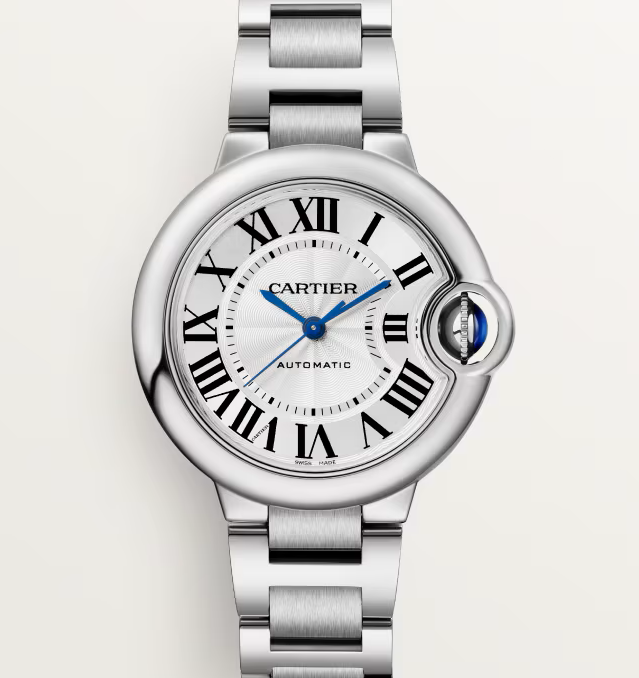
Ballon Bleu
Model History
Introduced in 2007, the Ballon Bleu de Cartier marked a significant turning point in the house's watchmaking history: after a century built mainly on square, oval and tonneau shapes, Cartier proposed for the first time with such breadth a collection with a round, softly convex case, designed to sit naturally on both the male and female wrist. The name itself, which in French means "blue balloon", directly evokes the rounded, gently swelling profile of the case.
The most recognizable element of the Ballon Bleu is the crown, topped with a blue cabochon — the sapphire-colored synthetic stone already used on other Cartier models since the early twentieth century — and protected by a metal arc that makes it appear almost suspended on the side of the case: a detail that combines function, shielding the crown from impacts, with aesthetics, immediately becoming the model's signature feature. The dial, with Roman numerals slightly curved to follow the convexity of the case and blue sword-shaped hands, nonetheless retains a clear visual link with the rest of Cartier's production.
Offered from launch in numerous sizes and materials, from the more accessible steel up to gold and diamond-set versions, the Ballon Bleu achieved immediate and lasting commercial success, quickly becoming one of the best-selling models in Cartier's entire catalogue and one of the few watches from the house designed explicitly for both a male and a female audience from its very conception.
Technical Specifications
Main Executions
The blue cabochon adorning the Ballon Bleu's crown is not an invention of 2007: this sapphire-colored synthetic stone already appears on some Cartier watches from the early decades of the twentieth century, confirming how even the brand's most modern model has its roots in a detail inherited from the maison's jewelry-making tradition.