

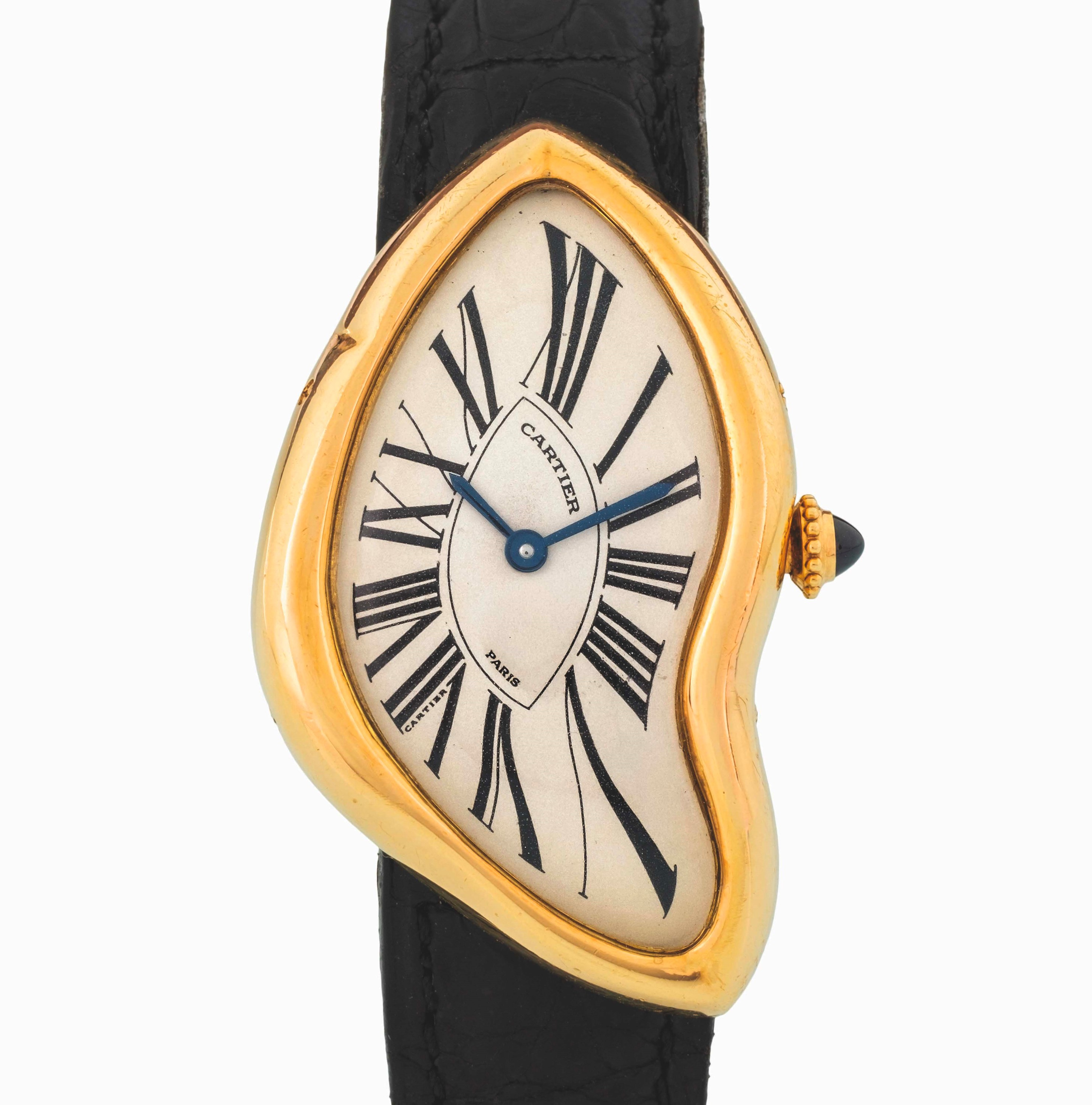
Crash
Model History
The Crash was born in 1967 in Cartier's London atelier, then led by Jean-Jacques Cartier, with a contribution from designer Rupert Emmerson. Contrary to the most widespread legend, according to which the model arose from copying a Baignoire damaged in a car accident, or from a direct inspiration from Salvador Dalí's melting clocks, there is no historical evidence supporting these accounts: the most recent research considers them after-the-fact anecdotes, never confirmed by the house's archives. What is documented is a path of deliberate experimentation starting from an oval case, progressively "squashed" and distorted through various shape trials until reaching the asymmetrical, melted appearance that characterizes it.
The result is a case that seems literally melted, with the dial's Roman numerals following the irregular outline rather than being arranged along a regular circumference or rectangle, as happens in every other Cartier model. It was a radical operation for its time, consistent with the experimental spirit of 1960s London, taking the exploration of shapes already begun by Cartier with the Tank and Tortue to its most extreme outcome.
The original London production remained extremely limited, making vintage pieces among the rarest and most sought-after in all of collectible watchmaking: a 1967 London Crash was sold at auction by Sotheby's for a record sum, confirming the almost mythical status the model has achieved. In 1991 Cartier Paris produced a reissue of about 400 pieces that retained the distinctive asymmetry of the original design while refining its proportions; since then the Crash has periodically returned to production, often in limited editions and in versions set with precious stones, remaining one of the most exclusive models in the catalogue.
Technical Specifications
Main Executions
Despite the "melted" name and appearance having fueled for decades the legend of an origin tied to a car accident or Salvador Dalí's surrealist art, the house's historians agree that both stories are myths never confirmed: the Crash was born from deliberately experimental design work, not an accidental event.