

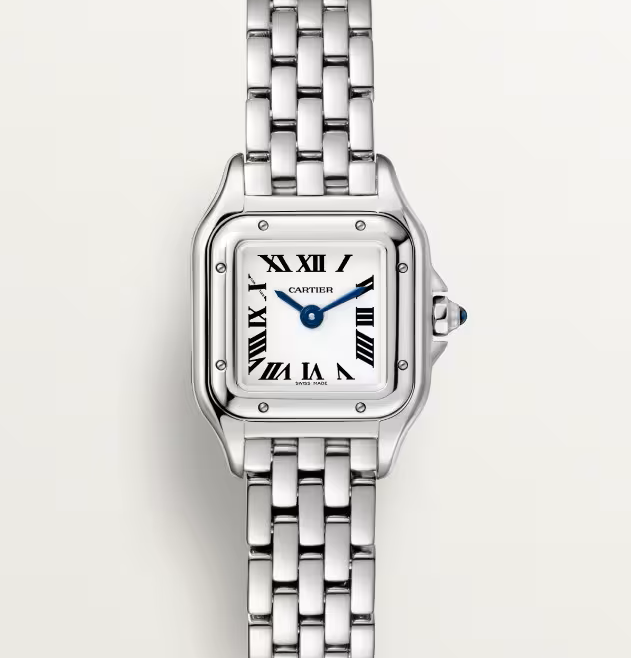
Panthère
Model History
The Panthère de Cartier debuted in 1983, at a moment when the house was seeking a model capable of fusing its watchmaking identity with its equally strong jewelry identity. The name and spirit of the project have their roots in a key figure of Cartier's history: Jeanne Toussaint, nicknamed "the Panther", creative director of the house from 1933 and the person behind the introduction of the feline motif in Cartier jewelry as early as 1915. The Panthère watch was thus born as a natural watchmaking extension of a symbol that had already belonged to the house's language for decades.
The design is based on a square case with a visible-screw bezel, in continuity with the aesthetic vocabulary already seen in the Santos, but the truly distinctive element is the bracelet: made of five rows of tightly interconnected links, closed by an almost invisible clasp, which slides over the wrist with an almost textile fluidity, closer to jewelry than to a traditional watch bracelet. Launched initially in solid yellow gold or in a steel-gold two-tone version, the Panthère quickly established itself as one of the style symbols of the 1980s, worn by celebrities and rock stars of the era, including figures such as Mick Jagger and Keith Richards.
1991 brought the turning point that greatly expanded its audience: an all-steel version, more accessible than the gold executions, which established the Panthère as one of the house's best-selling models of that decade. After a period of lower catalogue presence between the late 1990s and the 2000s, the model has been the subject of several targeted relaunches, the most recent in 2017, with the introduction of new rose gold and white gold variants and an updated clasp system, testifying to its lasting relevance in the brand's imagination.
Technical Specifications
Main Executions
Jeanne Toussaint, the woman who gave this model its nickname and part of its inspiration, was not a trained designer but a close friend of Louis Cartier, who entrusted her with the house's creative direction precisely for her instinctive taste: it was she, in the 1940s, who transformed the panther into a true Cartier emblem, still present today in jewelry as well as watchmaking.