

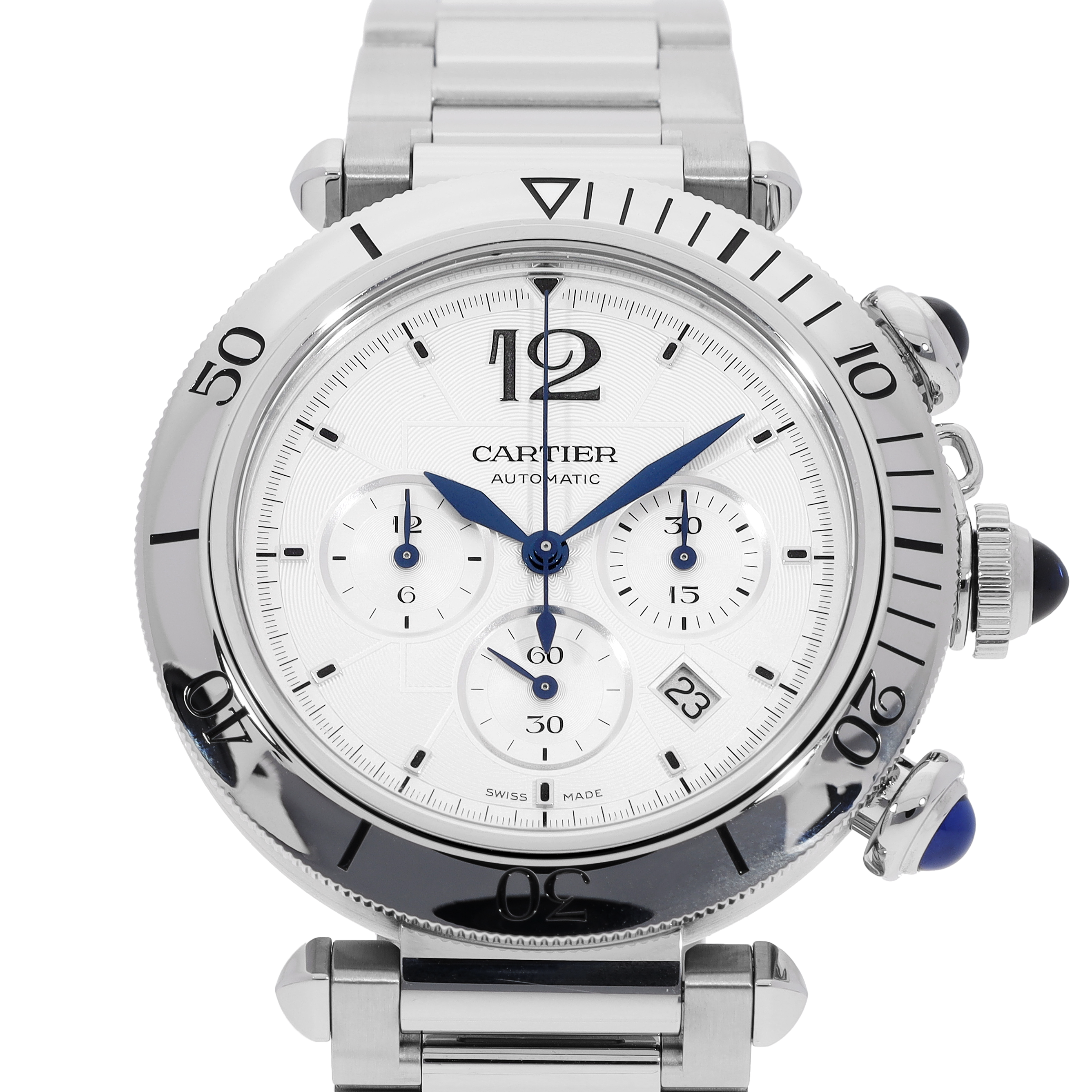
Pasha
Model History
The story of the Pasha's origins is wrapped in a legend that Cartier itself has helped to nurture: according to the account passed down, in the 1930s the Pasha of Marrakech, Thami El Glaoui, is said to have commissioned Louis Cartier for a robust, waterproof watch that could even be worn while swimming in a pool, giving rise to a prototype that would take his name. The house's historians have never found definitive documentary proof confirming the episode: the most concrete evidence is a 1943 photograph showing a similarly designed watch, but the origin remains more a founding anecdote than an established fact.
The Pasha as we know it today was born much later, in 1985, when Cartier's then-CEO, Alain-Dominique Perrin, entrusted Gérald Genta — a designer already responsible for some of the most celebrated sports watches of the twentieth century for other houses — with the task of reinterpreting that legend in a contemporary key. The result is a watch with a round 38 mm case, an unusual choice for a brand built almost entirely on geometric shapes, waterproof and characterized by a screw-down cap protecting the crown, secured to the case by a small chain to prevent its loss.
The dial, with an inner square circle marking the minutes overlaid on a circular background, vaguely evokes the aesthetic of a military watch, while the overall effect remains unmistakably luxurious. The success of the 1985 version paved the way, in the following years and decades, for numerous variants — chronographs, models with GMT indication, more complicated executions — that made the Pasha one of the few truly sporty watches in the catalogue of a brand more accustomed to formal elegance.
Technical Specifications
Main Executions
The small chain securing the crown cap to the case body is not just a decorative detail: it was created as a practical solution to prevent that component, essential to the watch's water resistance, from being lost during use — a technical feature that has become, over time, one of the Pasha's most immediate recognition marks.