

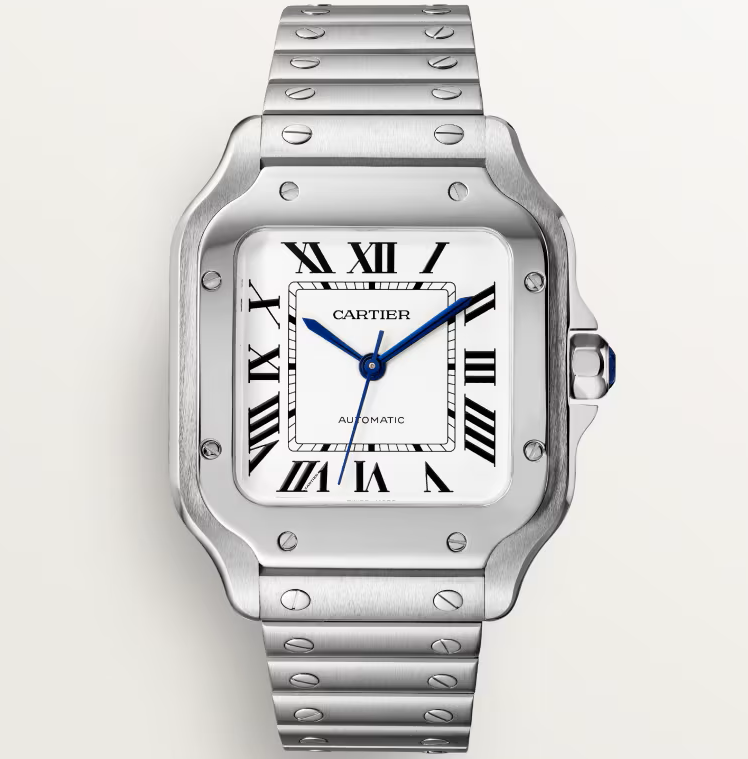
Santos
Model History
The Santos story begins with a practical problem. Brazilian aviator Alberto Santos-Dumont, a friend of Louis Cartier, complained about the difficulty of checking his pocket watch while at the controls of his aircraft, when both hands had to stay on the controls. Louis Cartier responded by making him, in 1904, a watch with a case fastened to the wrist by a leather strap and buckle: a solution as simple as it was revolutionary for an era in which the wristwatch was considered, when not entirely unknown, an almost exclusively feminine accessory.
The case chosen by Cartier is square, an unusual shape for an aviator's watch, with chamfered corners and a bezel fastened by visible screws that would become, over the years, one of the brand's most celebrated distinctive traits. Santos-Dumont's personal success, a famous aviator and much-photographed society figure of the era's press, helped popularize this new way of wearing time on the wrist: the question "what is that on his wrist?" accompanied the aviator's photographs and helped legitimize the wristwatch also for a male audience. Cartier began larger-scale production in 1911, in collaboration with movement maker Edmond Jaeger.
After decades in which the model remained a constant but low-key presence in the catalogue, 1978 marked a turning point: Cartier launched the "Santos de Cartier", with steel and steel-gold versions that made the model accessible to a broader audience without abandoning the original design. This was the start of the phase that cemented the Santos as one of the pillars of the brand's watch collection, with later updates — including the integrated bracelet with quick-adjustment system introduced in the most recent generation — that have renewed its relevance while keeping its identity intact.
Technical Specifications
Main Executions
Alberto Santos-Dumont was not just a devoted Cartier customer: he is considered by many aviation historians to be the first to make a publicly recognized and certified flight with a heavier-than-air motorized aircraft, the 14-bis, in Paris in 1906 — right during the period when he wore on his wrist the watch made for him by Louis Cartier.