

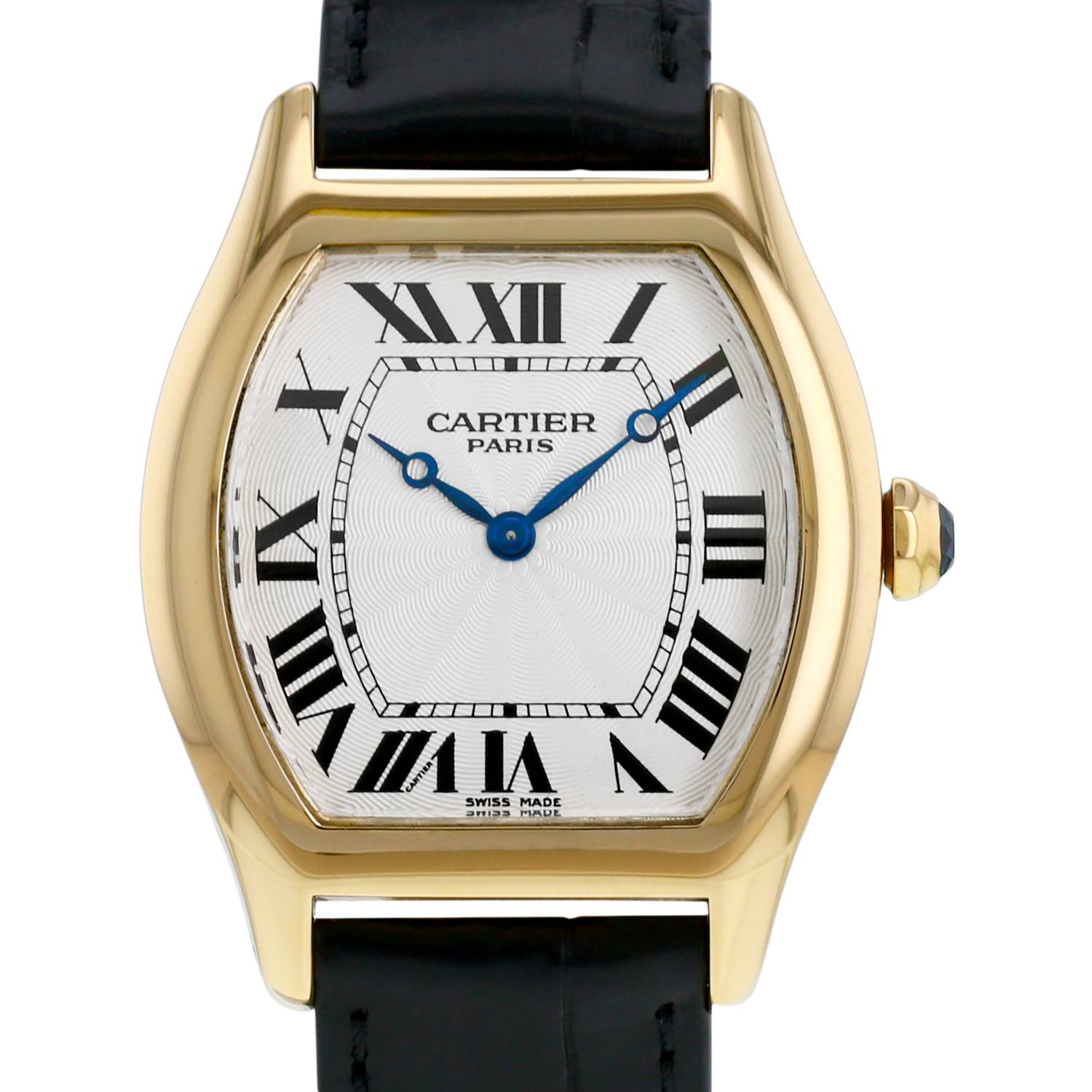
Tortue
Model History
The Tortue was born in 1912, right as Cartier began experimenting with case shapes alternative to the circle, still dominant in the era's watchmaking. The name, which in French means "tortoise", precisely describes its main characteristic: unlike the tonneau, curved only on its two short sides, the Tortue is domed on all four sides, with a soft, convex profile that indeed recalls a tortoise shell. It is one of the first non-round geometric shapes in Cartier's history, alongside the tonneau itself, and precedes by a few years the birth of the more famous Tank.
Originally conceived as an elegant evening watch, suited to the refined taste of the Belle Époque first and then Art Déco, the Tortue was produced in parallel by the Paris, London and New York offices, each with small variants for their own clientele, and it regularly housed movements supplied by third-party Swiss manufactures, notably Jaeger-LeCoultre. The dial, typically cream or white with black Roman numerals and blued steel sword hands, echoes the same aesthetic language that characterizes other Cartier creations of the period.
Among the executions most sought after by collectors is the Tortue Monopoussoir, a chronograph version controlled by a single pusher integrated into the crown, technically sophisticated for its time and today among the most coveted vintage Cartier pieces on the collector's market. Compared to the Tank, the Tortue has had a more discontinuous presence in the catalogue over time, alternating periods of absence with targeted relaunches, but it remains an essential reference for understanding the origins of Cartier's language of shapes.
Technical Specifications
Main Executions
Precisely because of its entirely domed shape, the Tortue is among the vintage models most delicate to preserve in original condition: its curved surfaces tend to round further with polishing over time, so much so that pieces with the case geometry still "sharp" are considered particularly prized by collectors.