

Model History
Until 1974 Casio was an electronic calculator company, not a watchmaker. With the Casiotron, introduced in November of that year with reference QW-02, the company entered the wristwatch market for the first time, bringing with it the expertise it had built in large-scale integrated circuits (LSI) developed for its own calculators. The name itself, a fusion of "Casio" and "electron", openly declared the project's intent: a watch conceived and built with the mindset of consumer electronics, not traditional watchmaking.
The feature that made the Casiotron a genuine technical leap was its calendar: the digital liquid-crystal dial displayed the time, month, date and day of the week with logic able to recognize on its own the varying length of the months (28, 30 or 31 days), without the user needing to manually correct the date at every month change — with the sole exception of leap years. This is why the Casiotron is commonly remembered as one of the first watches in the world, if not the first, equipped with a truly automatic perpetual calendar on a wrist quartz movement.
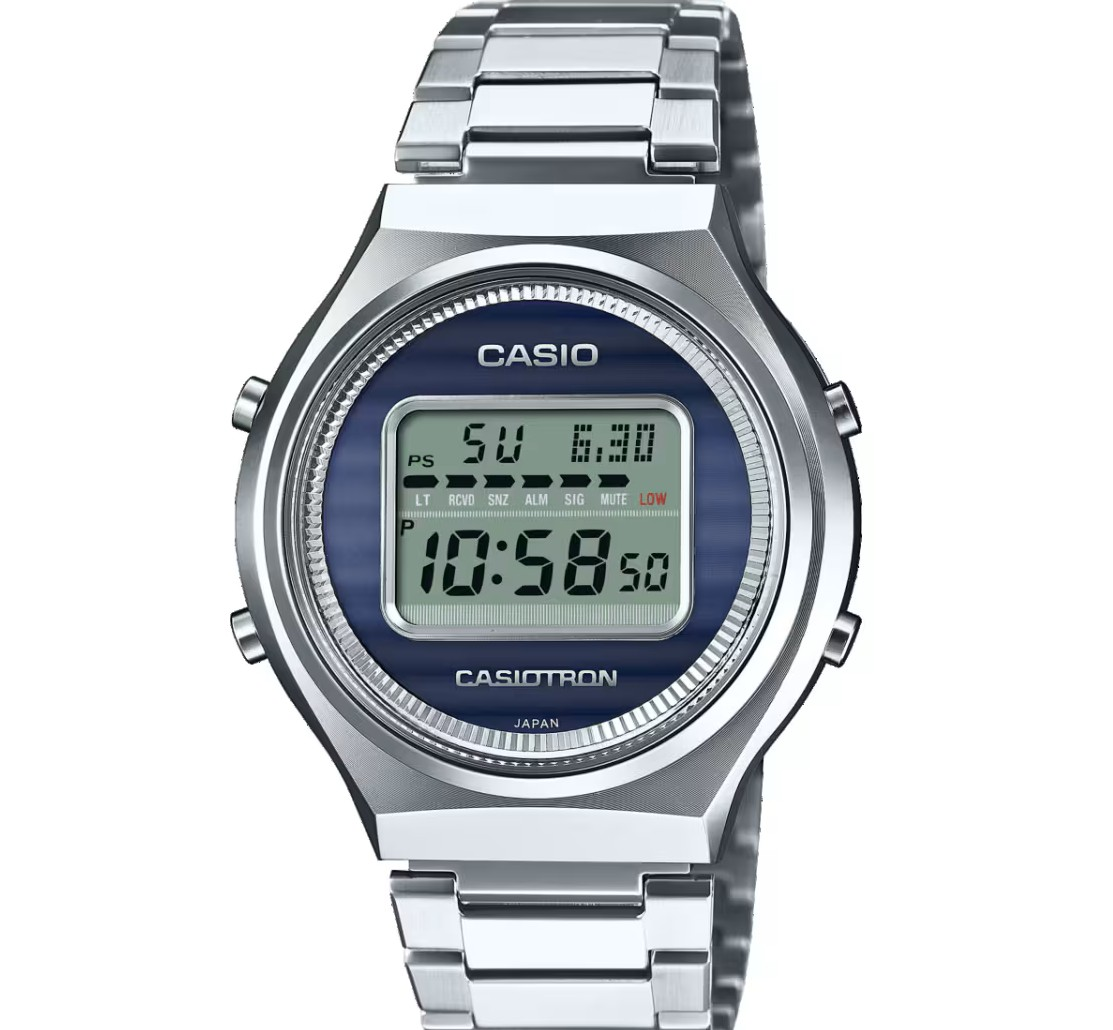
The historical moment of its arrival was no coincidence: the first half of the 1970s was the period of the so-called quartz crisis, which was reshaping the entire watch industry at the expense of traditional mechanics. While historic Swiss brands struggled to adapt, Casio — coming from consumer electronics rather than watchmaking — found itself ideally positioned to ride that change. The Casiotron thus paved the way for decades of Casio watches built on the same logic: digital circuitry, practical functions, accessible price. In 2024, for its fiftieth anniversary, Casio celebrated its legacy with a limited reissue (TRN-50), faithfully reproducing the original aesthetic while adding modern technologies such as solar charging and Bluetooth connectivity.
Technical Specifications
Main Executions
The Casiotron's DNA — consumer electronics applied to the wrist, practical functions ahead of aesthetics — is the same DNA that in 1983, nearly ten years later, would lead Casio to launch G-Shock: a line that became so important it merits separate treatment in Chronopedia, but which has its roots precisely in the approach pioneered by this first 1974 watch.