

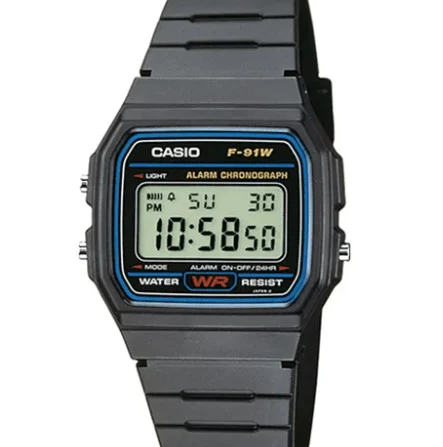
F-91W
Model History
Introduced in June 1989 as the successor to the earlier F-87W, the F-91W began as just one of many budget digital watches in Casio's catalogue of the time, designed by Ryūsuke Moriai in his debut as a designer for the company. At launch, no one could have predicted it would become one of the most produced and best-selling watches in the history of watchmaking: over the decades production has surpassed hundreds of millions of units, making it one of the most widespread models ever made, digital or mechanical.
The secret to the F-91W's success was never technical, but a matter of balance: an extremely light resin case (just 21 grams), an integrated resin strap, a clear LCD display with calendar, chronograph to the hundredth of a second, daily alarm and hourly chime, all powered by a single CR2016 battery with a stated lifespan of several years. No superfluous features, a list price that has always remained very low, near-total reliability: characteristics that made it an "invisible" watch in the daily lives of generations of people worldwide, from the 1990s to today, with a design that has remained essentially identical to itself.
This very widespread ownership gave it, over time, an unexpected and in some ways paradoxical notoriety: in the 2000s the F-91W was repeatedly linked by international media to possible use as a timer in improvised explosive devices, to the point of repeatedly appearing in documents relating to detainees at the Guantanamo base as presumed evidence of affiliation. A controversial chapter that has not, however, dented its popularity, while unofficial imitations remain numerous to this day precisely because of its low cost and instant recognizability.
Technical Specifications
Main Executions
Despite being among the lowest-priced watches in the entire Casio catalogue, the F-91W is among the most produced watches in the history of watchmaking: a milestone reached while remaining, for over thirty years, almost identical to the model introduced in 1989 — the best demonstration of how, for Casio, function has always mattered more than aesthetic novelty.