

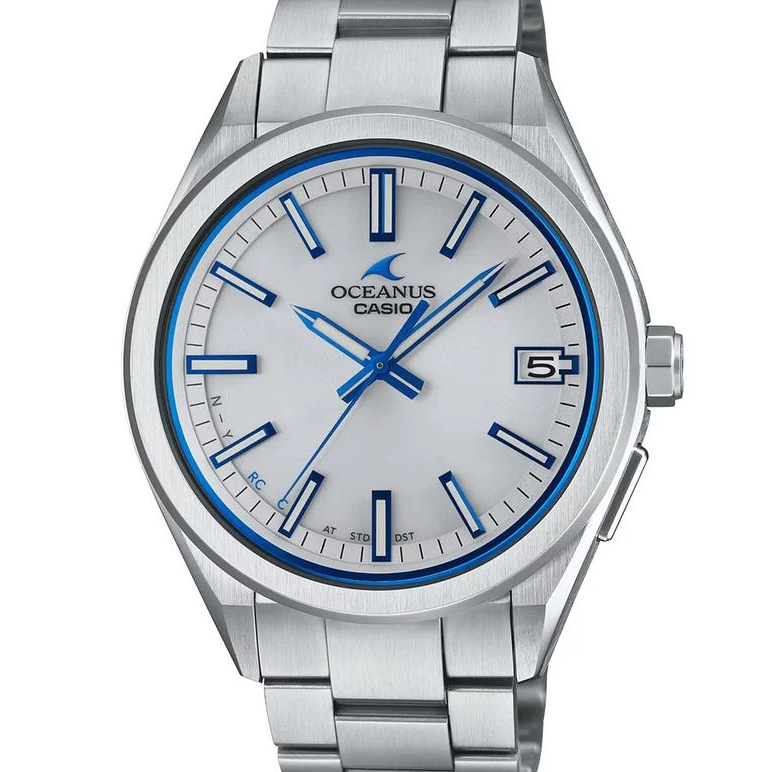
Model History
Oceanus debuted in 2004 with the OCW-500, presented at the time as the world's first all-metal chronograph combining solar charging, radio-controlled reception and a world-time function. The line's name, taken from Oceanus, the sea-related titan of Greek mythology, accompanies a wave-pattern logo that the brand describes as a synthesis of soft curves and decisive lines: an image meant to convey both technical refinement and a more adventurous spirit than the Casio catalogue's other high-end lines.
Unlike G-Shock or Pro Trek, built around the idea of resistance and extreme use, Oceanus pursues what Casio itself calls a dual precision: chronometric precision, guaranteed by solar-powered movements and radio-signal synchronization, and constructive precision, with all-metal cases of slim profile, curved lugs and sapphire crystals with anti-reflective treatment. Over the years the line has accumulated a series of distinctive technical milestones: Multiband 5 reception in 2006, what Casio presented as the world's thinnest chronograph movement in 2007, six-motor hand-drive systems in 2013, hybrid GPS technology in 2014 and, in 2017, three-way Bluetooth connectivity combined with GPS.
Oceanus remains a line designed mainly for the Japanese domestic market, where it competes directly with the more elegant offerings from Seiko and Citizen, while remaining relatively less distributed internationally compared to G-Shock or Edifice: a positioning choice that has made it, for enthusiasts outside Japan, something of a well-kept secret of the Casio catalogue.
Technical Specifications
Main Executions
Some particularly slim Oceanus models, such as the OCW-S100 series, are known among enthusiasts by the informal nickname "Manta", inspired by the case's tapered profile: a name never officially adopted in the Casio catalogue but now firmly established in collectors' vocabulary.