

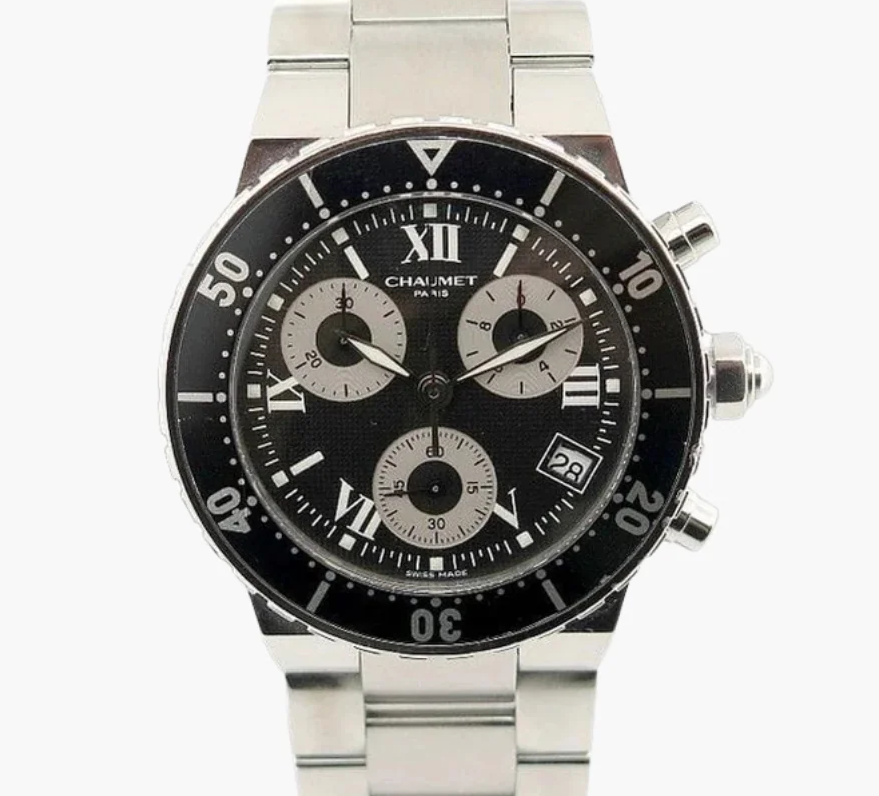
Model History
Launched in 1998, the Class One was born with a stated ambition from Chaumet: to be the first dive watch conceived according to the codes of jewelry, at a time when the women's sport-watch segment was still little explored by Parisian high-jewelry houses. The round case, unidirectional rotating bezel and screw-down crown echo the technical setup of a genuine dive watch, but reinterpreted with proportions and finishes designed for an audience that also regards the watch as a style accessory.
Over the course of the 2000s the collection was enriched with numerous variants: cases in steel or titanium, lacquered dials in different colors, bezels set with diamonds and interchangeable straps — in rubber, grosgrain satin or on a metal bracelet — designed to adapt the same watch to different occasions. One of the best-known interpretations, the Class One Chaumet Paris presented in 2013, offered for example three different straps supplied with the same case.
While remaining faithful to its original sporty design, the Class One has over the years also hosted more overtly jewel-like versions, with bezels and cases entirely paved with diamonds, confirming the logic with which Chaumet has always treated watchmaking: as ground on which to apply its own jeweler's know-how, rather than as a discipline in its own right.
Technical Specifications
Main Executions
At launch, in 1998, Chaumet promoted the Class One as "the first jewel dive watch": an unusual positioning for a house founded two centuries earlier as a court jeweler, which with this collection explicitly measured itself against the technical codes of sports watchmaking for the first time.