

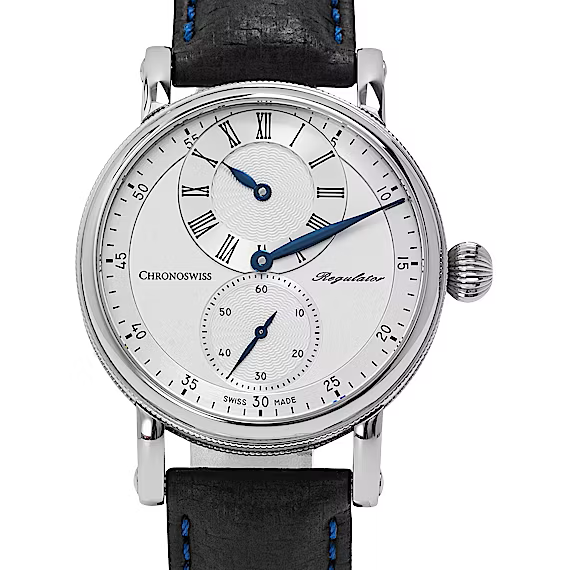
Régulateur
Model History
Introduced in 1987, just four years after the brand's founding, the Régulateur is the model that established Chronoswiss as an independent manufacture: it is the world's first wristwatch to bring the "regulator" dial into series production, a layout until then reserved for the great workshop and observatory clocks, in which the minutes occupy the center of the dial while the hours and seconds are relegated to separate subdials, to guarantee maximum legibility of the most important reading in precision timekeeping.
Around this layout, Gerd-Rüdiger Lang built an entire aesthetic language that would become Chronoswiss's signature: the oversized "onion" crown, the knurled or fluted bezel and case flanks, and the straight lugs with visible screws that recall exposed mechanics rather than hiding them. The automatic movement powering the first series, the C.122 caliber, derives from an Enicar 165 base appropriately modified by Chronoswiss with a dedicated module for separating the three time indications.
In the following decades the Régulateur has remained the heart of the catalogue, declined in numerous case and dial variants and, since 2016, joined by the Flying Regulator Open Gear version, which reinterprets the same principle with three-dimensional funnel-shaped counters and exposed bridges, carrying the original 1987 idea toward a more skeletonized, contemporary aesthetic.
Technical Specifications
Main Executions
Before Chronoswiss's Régulateur, the regulator dial was exclusive to table or wall clocks used in watchmaking workshops to time the adjustment of other movements: bringing it to the wrist, in 1987, meant offering the public the watchmaker's own "working" aesthetic as an object to be worn every day.