

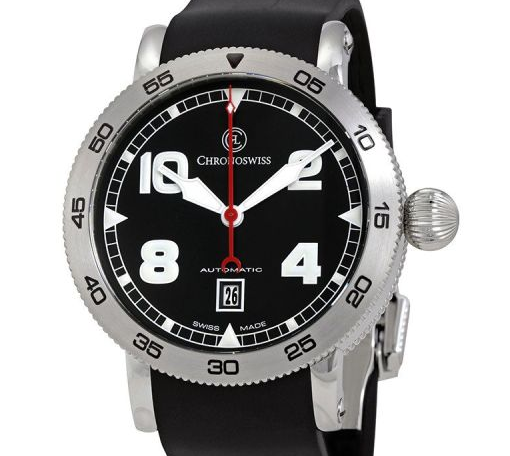
Timemaster
Model History
Launched in 2000, the Timemaster marks a turning point from the strictly neo-classical language with which Chronoswiss had established itself in the 1980s and 1990s: the case grows to 44 mm, dials become more contrasted and legible, and the overall design moves closer to that of an instrument chronograph, designed for quick reading of elapsed time rather than formal wrist elegance. Yet the brand's attention to constructive detail remains intact, from the more imposing crown to the visible finishing on the movement.
Over the years the line has expanded with numerous complications useful to travelers and sportsmen: GMT versions with a second time zone, flyback chronographs able to reset and restart the count with a single push, pointer-date functions with a central hand dedicated to the date, and day-date variants. The Timemaster Chronograph Skeleton, with an exposed skeletonized mainplate and bridges, represents the most explicit meeting between the line's instrument-driven soul and the tradition of constructive transparency that has accompanied Chronoswiss since the 1987 Régulateur.
The Timemaster allowed the brand to address an audience more oriented toward sporty and travel chronographs, expanding the catalogue beyond the reinterpreted pocket-watch aesthetic that characterizes the Régulateur and Kairos, while still featuring manufacture or extensively modified automatic movements and finishing quality consistent with the brand's independent positioning.
Technical Specifications
Main Executions
At 44 mm in diameter, the Timemaster is among the largest cases ever made by Chronoswiss: a sharp change of scale compared to the 38 mm of the original 1987 Régulateur, reflecting the gradual shift in watchmaking taste toward generously sized instrument chronographs between the late 1990s and early 2000s.