

Eco-Drive
Model History
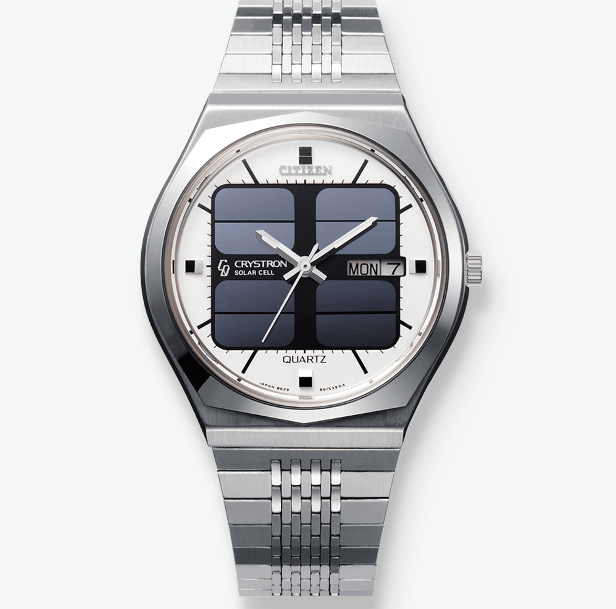
Development began in 1974, in the wake of the global energy crisis, when industry in general, watchmaking included, looked with new interest at alternative energy sources. In 1976 Citizen launched the Crystron Solar Cell, presented as the world's first analog quartz watch powered by a solar cell: eight monocrystalline silicon cells guaranteed up to five years of power reserve at full charge, with a declared accuracy within 15 seconds per month. The hardest technical challenge was not generating energy from light, but storing it: no compact rechargeable battery suited to the purpose yet existed, and Citizen's engineers had to design a circuit capable of managing hydrogen development inside the rechargeable silver batteries then available.
In the following years the technology matured rapidly: in 1986 the introduction of amorphous silicon cells paired with an electric double-layer capacitor extended the power reserve to about 200 hours of continuous operation in darkness. It was in the first half of the 1990s that the brand officially adopted the name "Eco-Drive" for this family of calibers, and in 1995 came a clear leap in power reserve, up to six months. In 1996 an Eco-Drive model became the first watch in Japan to receive the Eco Mark environmental certification, a recognition that publicly reinforced the technology's central argument: no disposable battery to dispose of.
Refinement has continued to the present day: 2000 brought the radio-controlled Eco-Drive, which receives the time signal and drastically reduces maintenance; 2011 the A010 caliber, accurate within ±5 seconds per year; 2019 the flagship 0100 caliber, five times more accurate than its predecessor, within ±1 second per year, among the most accurate quartz movements ever mass-produced; 2023 the "Eco-Drive 365" variant, capable of a full year of power reserve at full charge even without further light exposure. Today the technology equips the majority of the Citizen catalogue, from elegant collections to the Promaster diving lines: more than a single model, it has become the technical trait that defines the brand.
Technical Specifications
Main Executions
In 1976 there was not yet, on the market, a rechargeable battery compact enough to fit inside a watch: Citizen's engineers literally had to invent a circuit to manage hydrogen development inside the rechargeable silver batteries of the era, before they could even make the Crystron Solar Cell practical.