

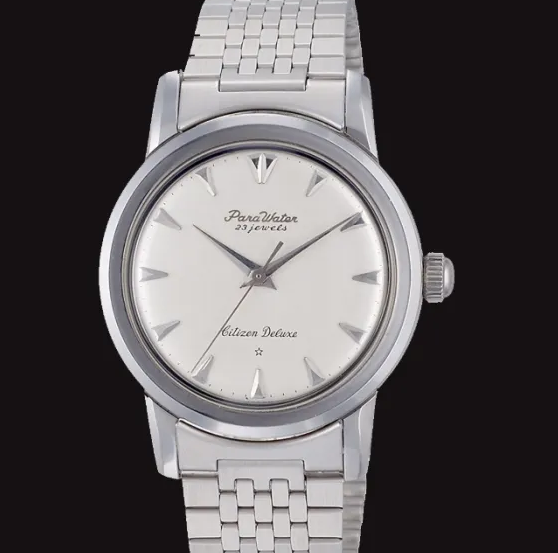
Parawater
Model History
In the late 1950s, dial water resistance was one of the great research topics of the Japanese watch industry. Citizen responded in 1959 with the Parawater, officially presented in the July-August issue of the internal bulletin Citizen Business News as the first waterproof watch made in Japan: a technical milestone, even before a commercial one, for an industry that until then had depended almost entirely on imported solutions.
The central innovation was the use of O-ring gaskets made of nitrile butadiene rubber, applied at the four critical points of the case: crystal and bezel, caseback, crown tube and the inside of the crown itself. A technology conceptually derived from American military aviation's hydraulic systems, adapted to the tiny scale of a wristwatch. The original movement was the Citizen Deluxe manual-winding caliber, 19 jewels; period testing attested a resistance of about 0.5 atmospheres, the equivalent of a few meters of water — modest by later standards, but a genuine engineering leap for 1959.
The Parawater was not conceived as a diver's watch: it was initially aimed at people working in contact with water, dust and sweat, with the promise of being able to wear it without ever having to take it off. It is precisely this water-resistance know-how, refined over the years through variants such as the Parashock and modern reissues like the Kuroshio '64 from the Citizen Asia Limited Series, that laid the direct groundwork for the brand's future diving line: without the Parawater, neither the Aqualand nor the Promaster would exist a quarter of a century later.
Technical Specifications
Main Executions
The O-ring gasket principle that made the Parawater possible did not originate in watchmaking but in aviation: the technology was already used in the hydraulic systems of American military aircraft, and Citizen reinterpreted it on a watchmaking scale to solve a problem the entire Japanese industry considered, at the time, among the hardest to address.