

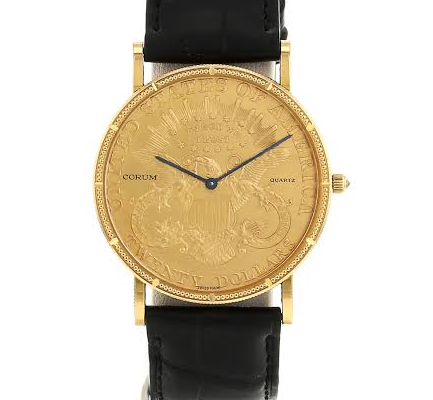
Model History
The idea for the Coin Watch was born in the early 1960s, after the spread of sapphire crystal made it possible to build ultra-thin, resistant cases even from unconventional materials. Corum thus had the idea of using a genuine American $20 gold coin — the "Double Eagle", so named to distinguish it from the $10 coin known as the "Eagle" — as the case and dial of a wristwatch. The model was created and registered in 1964, and the first twelve units made were sold before they could even be officially presented at the 1965 Basel Fair.
Making each Coin Watch involves delicate work: the original coin is precisely turned and hollowed out to make room for the movement, without compromising its appearance or its historical and collectible value. On the two flat faces of the coin, at 9 o'clock and 3 o'clock, the words "Corum" and "Automatic" are engraved: a detail that allows the watch to be recognized while keeping the original coin's image intact. In the earliest versions the mechanical heart is an automatic Frederique Piguet caliber, custom-made for Corum.
Over the decades the Coin Watch has become a genuine status symbol, worn by several US presidents and numerous public figures. Corum has used coins minted in different years, effectively making each example a piece unto itself, and alongside the historic mechanical versions it has also offered more recent quartz-movement variants. Together with the Golden Bridge, it remains one of the most extreme examples of the brand's inclination to build watches from materials and concepts no other manufacturer would have considered.
Technical Specifications
Main Executions
The Coin Watch's immediate success — sold before it was even shown at the fair — anticipated by a few decades another Corum idea built on the same instinct to surprise with case shape: the Bubble collection, launched in 2000 under Severin Wunderman, with its domed sapphire crystal disproportionately large compared to the rest of the watch. Two different ways of telling the same story about the brand's attitude toward unconventional shapes.