

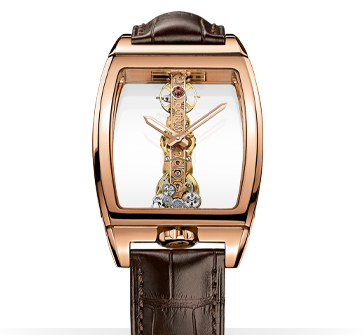
Model History
The idea for the Golden Bridge was born in the 1970s from the insight of self-taught watchmaker Vincent Calabrese, following a memorable work episode: a client, needing a movement hidden under the dial repaired, told him that since no one would ever see it, there was no need to repair it with care. A remark that, by Calabrese's own account, struck him deeply and pushed him to design a movement conceived from the outset to be shown, not hidden.
Calabrese thus developed a fully linear, "baguette" caliber, made of 45 components arranged in a row along a single axis rather than the traditional circular form: a patented design that won the gold medal at the Geneva International Exhibition of Inventions in 1977. The main technical challenge — avoiding the need for two separate crowns, one for winding and one for setting the time — was solved with an original solution that allows the movement to remain visible on both sides. Corum, under founder René Bannwart, recognized the invention's potential and launched it officially in 1980 at the Basel Fair, to mark the brand's 25th anniversary: the original tonneau-shaped 18K gold case encloses the movement between two sapphire crystals, giving the impression that it floats in mid-air, held only by the golden "bridge" that gives the model its name.
Over the following decades the Golden Bridge has been enriched with new interpretations, always keeping the linear movement as the protagonist: rectangular cases inspired by Art Deco, round versions, the titanium Ti-Bridge of 2009 with the CO 007 caliber, and tourbillon versions. 2011 brought a major turning point with the CO313 caliber, the first linear baguette movement with automatic winding and a platinum oscillating weight, making the concept accessible to those seeking an automatic watch rather than only a manual-winding one.
Technical Specifications
Main Executions
The Golden Bridge is considered one of the very few "baguette" linear movements to have achieved genuine, lasting commercial success in the history of watchmaking: nearly all mechanical complications, before and since, have relied on the movement's traditional circular form, while Calabrese demonstrated that a caliber could be as beautiful to look at as it was complex to build.