

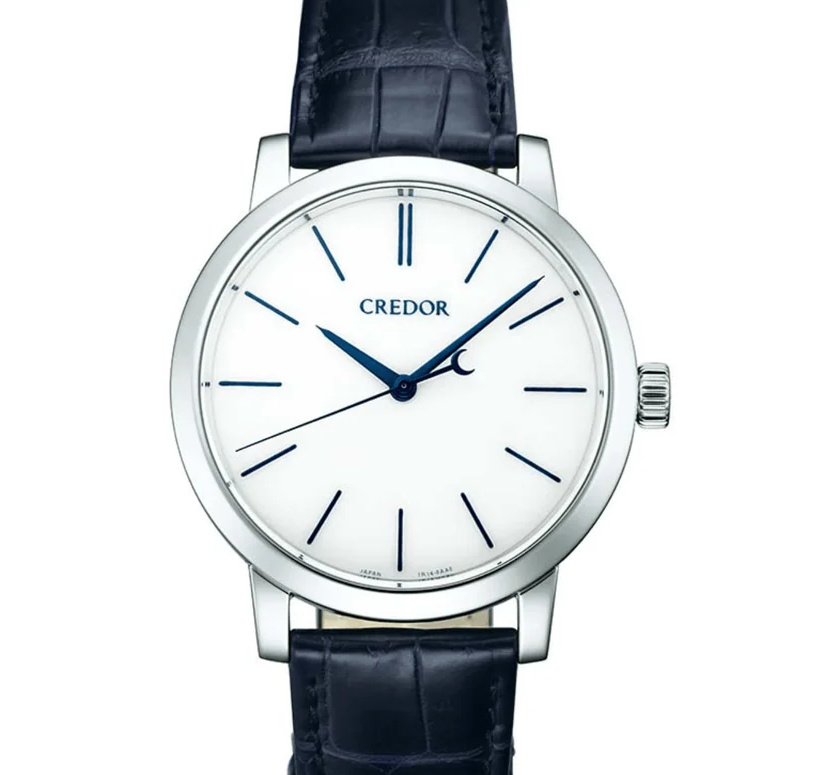
Eichi
Model History
The Eichi was born in 2008 as the model that, according to many industry observers, finally gives full expression to Credor's identity as a standalone high-watchmaking brand, distinct from Grand Seiko's practical robustness. It is a time-only watch, without complications, conceived as a statement of subtle elegance: a platinum case, a white enameled porcelain dial with hand-applied indexes, all assembled in extremely limited numbers at the Micro Artist Studio in Shiojiri.
The original version, now known as the Eichi I, carried an ultra-thin mechanical caliber with a power-reserve indicator and was limited to 25 pieces. To make it, the Micro Artist Studio's artisans worked extensively on hand-finishing techniques, even bringing the renowned Swiss finisher Philippe Dufour to Japan to pass on his beveling methods, and they selected specific Japanese woods to use as backing for the mirror-polishing of components.
The Eichi II, presented some years later, takes the concept to a further degree of synthesis: an even more essential dial, without a power-reserve indicator, and a manual-winding Spring Drive movement (caliber 7R14) that combines the tradition of the mechanical mainspring with Spring Drive's electronic regulation, a typically Japanese hybrid solution. The dials, made from translucent multilayer porcelain, require artisans with years of training in ceramics; the "Ruri" blue-dial version, introduced in 2020, is among the line's most celebrated variants.
Technical Specifications
Main Executions
To teach the Micro Artist Studio's artisans the most refined techniques of hand-beveling and finishing, Credor brought Philippe Dufour, one of the most respected finishers in independent Swiss watchmaking, to Japan: an unusual episode of direct craft-knowledge exchange between Switzerland and Japan, rarely told in this detail outside Japan itself.