

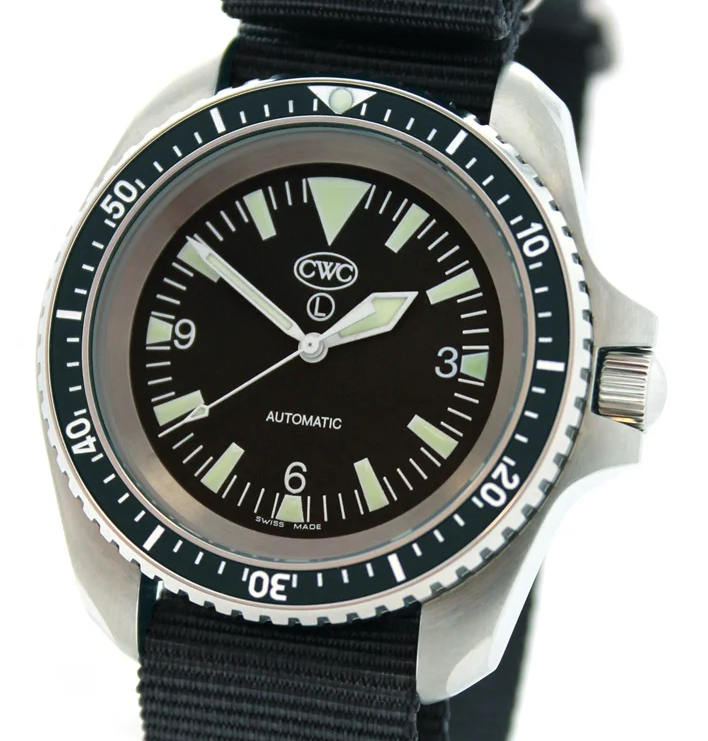
Royal Navy Diver
Model History
In the same 1980 in which it introduced the G10, CWC also won the Royal Navy contract for the diving watch to be issued to its own divers, who until then had been equipped with the Rolex Submariner and Omega Seamaster supplied by the Ministry of Defence. CWC's selection, driven by much lower costs and a construction philosophy explicitly designed for military use, marked the start of a line of diving watches the company still produces today.
A few years later, in the late 1980s, CWC developed a version specifically intended for the Special Boat Service, the Royal Navy's elite amphibious unit: the first batch of 100 units was delivered in 1988. Compared to the luxury automatic models it replaced, the quartz movement was chosen precisely for its greater reliability and shock resistance in extreme operational conditions, a criterion CWC applies systematically across its entire military production.
Over time the model evolved through several production batches: the 1988 examples carry a bezel with an acrylic insert, replaced from 1992 by a metal insert with wider markers; the crystal, originally mineral, was replaced by sapphire in more recent versions, while tritium gave way to Super-LumiNova. Beyond the SBS, the watch has over time also been supplied to the SAS, Royal Engineers, Royal Marines and other British units, becoming, together with the G10, one of the two most representative models in the entire CWC catalogue.
Technical Specifications
Main Executions
The Royal Navy Diver / SBS is often cited as one of the rare military watches still worn, in a form substantially faithful to the original, by British special forces operators: a continuity that has made it a genuine cult reference among military watch collectors even outside the United Kingdom.