

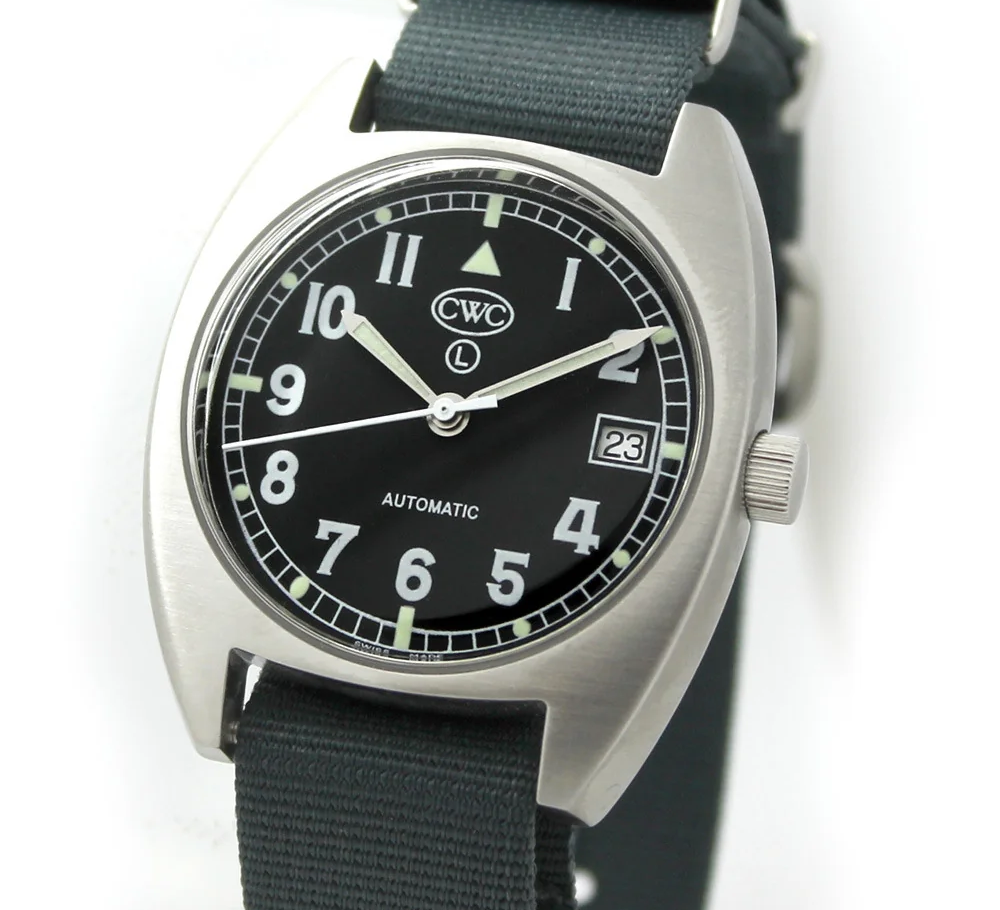
Model History
The W10 was born in CWC's very first years, the company founded in 1972 by Ray Mellor to take over the military contracts Hamilton had left vacant by shutting down its British division. Conceived as a mechanical general-service watch, the W10 was meant to replace, on the wrists of British soldiers, sailors and airmen, the models previously supplied by Hamilton, while keeping the same essential philosophy: an instrument built to withstand extreme operational conditions, not to impress with fine finishing.
Technically the W10 is based on the ETA 2750 manual-winding caliber, equipped with a hacking seconds mechanism essential for synchronizing time across different units during operations. The monoblock case, with lugs fixed integrally into the watch body, eliminated one of the weakest points of field watches of the era — the accidental detachment of the lugs — in favor of a ruggedness designed for daily use in difficult conditions. The matte black dial with Arabic numerals and tritium lume, paired with the classic NATO strap, rounded out a layout that would become an aesthetic reference for the entire category of military field watches.
The first batches of the W10 were supplied to the British armed forces starting in the early 1970s, with unit markings attesting to its cross-service use among the Army, Navy and Air Force. Though it remained in service for a relatively limited period before being progressively joined and then superseded, from 1980 onward, by the G10's quartz movement, the W10 remains today one of the most sought-after models among military watch collectors and a name CWC continues to use for certain civilian reissues inspired by the original.
Technical Specifications
Main Executions
The name of the company that makes the W10 conceals a small literary tribute: CWC, Cabot Watch Company, is named after the explorer John Cabot, chosen by founder Ray Mellor to evoke the idea of a venture setting out "into uncharted waters" in British military watchmaking — an origin more narrative than technical for a watch born, instead, with the very concrete purpose of replacing Hamilton as a supplier to the Ministry of Defence.