

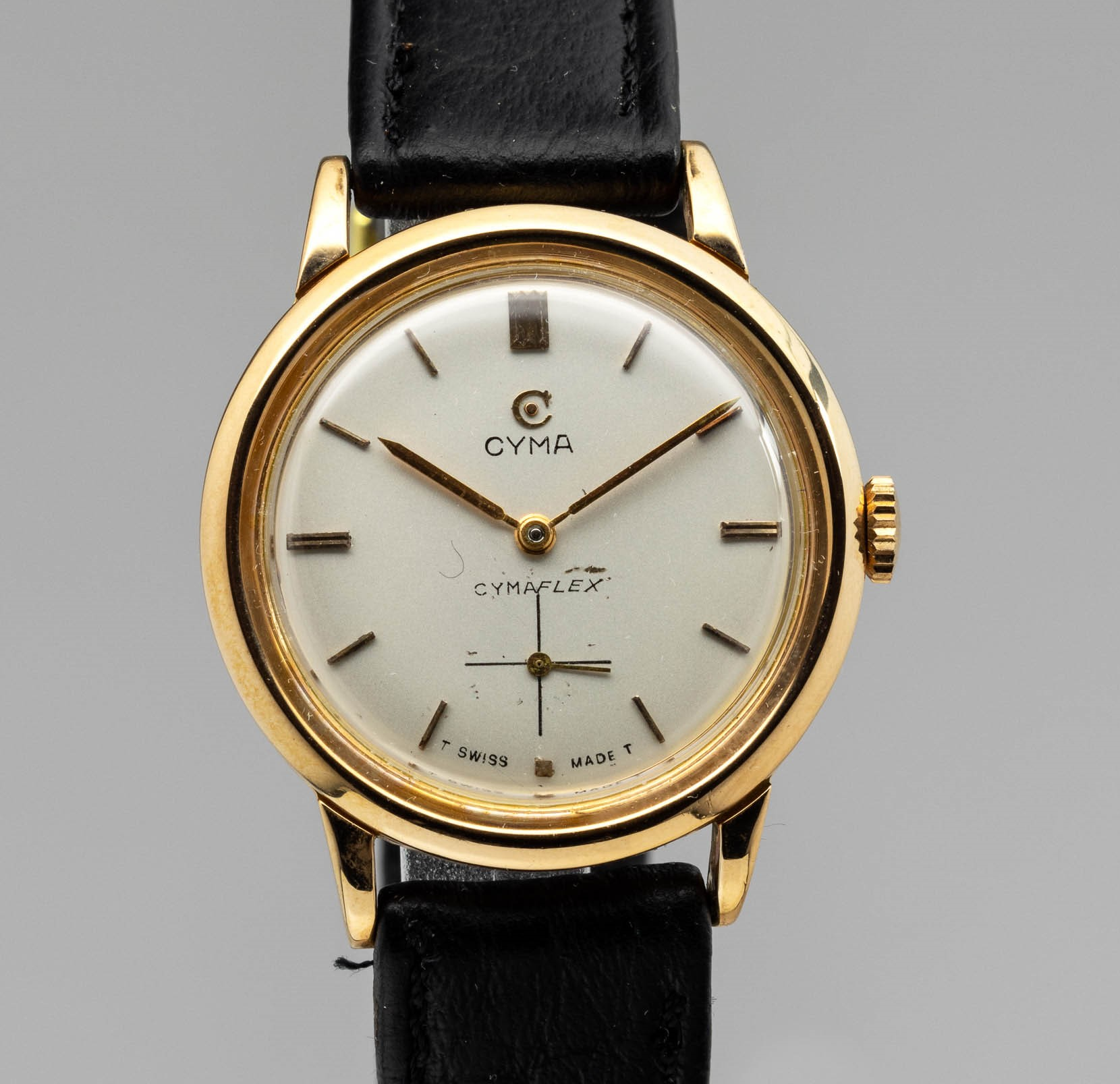
Cymaflex
Model History
In the 1950s the Swiss watch industry was engaged in a genuine race to protect the balance wheel, the most delicate component of a mechanical movement: its pivots, just a fraction of a millimeter long, can break or bend from a shock. Systems such as Incabloc became a widespread standard among many manufacturers; Cyma responded with its own patented solution, the Cymaflex, which the company went so far as to describe in its advertising as "one of the most important and valuable inventions in the history of watchmaking".
The Cymaflex principle is a ruby bearing placed at each end of the balance staff, able to absorb the energy of a shock and so protect the heart of the movement. Cyma did not limit itself to using it as a technical component: it made it the name of an entire line of city watches, produced in various executions — in steel with a chromed caseback or in 9 to 18 carat gold — often with the "Cymaflex" name made visible on the dial or caseback, a direct signal to the customer of the mechanism's reliability.
The Cymaflex technology and name were not confined to city watches: they also appeared on models with a more sporting character produced in the same years, such as the Navystar, a sign of how central shock resistance had become to the brand's commercial positioning at a time when Cyma claimed, across the whole of its production, over twenty patented technological innovations.
Technical Specifications
Main Executions
In period advertising material Cyma described the balance-staff pivots protected by the Cymaflex with almost scientific-manual detail: just 1/75 of an inch long and 3/1000 of an inch in diameter, an extreme miniaturization the brand used to explain to the public, in simple terms, why a shock-resistant system was so valuable in a mechanical watch.