

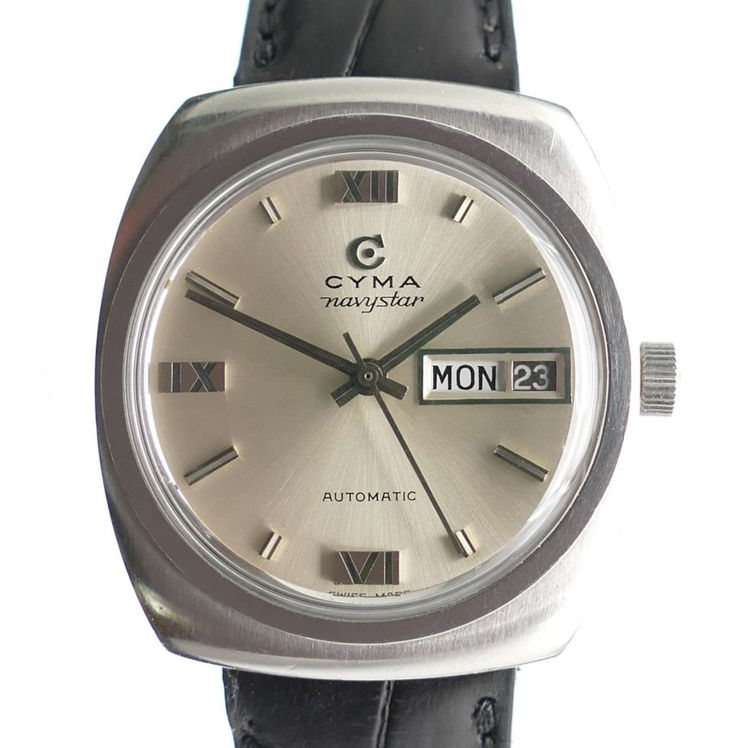
Navystar
Model History
Introduced in the 1950s and continued into the following decade, the Navystar line was Cyma's proposal for an audience seeking a sturdier, more casual watch than the city models, without giving up a slim, elegant profile. The name, with its nautical evocation, fits into the vein of "waterproof watches for everyday use" on which Cyma built much of its communication since the 1910s — though it should be noted this was a rugged everyday watch, not a strictly certified diving instrument.
Over the course of its production the Navystar was offered with a wide range of dials, hands and calibers, both manual and — in later executions — automatic, a sign of a line designed to adapt to different tastes and eras rather than stay fixed in a single configuration. A recurring element, however, remains the "Cymaflex" name visible at the bottom of the dial, signaling that even these sportier watches shared the patented shock-resistant system the brand applied broadly across much of its production.
As with much of Cyma's historical catalogue, Navystar production was affected by the decline of in-house manufacturing in the mid-1960s and the brand's subsequent changes of ownership. Today Navystar examples represent, for collectors, a relatively affordable entry point into Cyma's postwar "sport-casual" watchmaking, particularly prized when the original dial and Cymaflex name remain intact.
Technical Specifications
Main Executions
On several Navystar examples the movement's ratchet wheel still carries the engraving "Tavannes", the name of the manufacture from which Cyma was born in the early twentieth century: a detail that shows how long the industrial bond between the two houses remained alive within the movement components themselves, even many decades after their formal separation.