

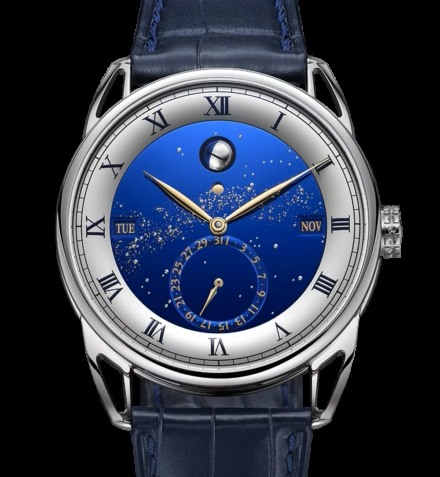
DB25
Model History
The DB25 was conceived as De Bethune's classic round line, the natural showcase for the complication that, more than any other, made the manufacture famous: the spherical moon, patented in 2004 and first introduced on the DB15's caliber. Recognizable for its drum-profiled case and its pierced lugs, which lighten its side view, the DB25 has over the years become the ground on which Denis Flageollet has grafted calendars, GMT displays, single-pusher chronographs and even digital time displays, following a philosophy he himself summed up by saying that every De Bethune watch is "the sketch for the next one".
Among the executions that have marked the line's history, the DB25L Moon Phase Starry Sky stands out, with its characteristic "starry sky" dial achieved through the natural bluing of titanium, and more recently the DB25Vxs Silver Moon, presented roughly fifteen years after the DB25L as a reinterpretation of it in a reduced format, designed for a smaller wrist while keeping the original case profile and pierced lugs intact.
Precisely because of its versatility as a platform, the DB25 has also hosted more experimental variants over the years, such as the meteorite dials of the Starry Varius line or the jumping-hour "Digitale" versions, confirming the collection's role as a place where De Bethune tests new aesthetics and new complications even more than as a single model with a fixed design.
Technical Specifications
Main Executions
The DB25's spherical moon is not a simple printed disc, as on most moon-phase watches: it is a small real sphere in palladium and blued steel that rotates on its own axis, achieving an accuracy — an error of just one day roughly every 122 years — far superior to that of traditional mechanisms, which typically drift out of alignment after only a few years.