

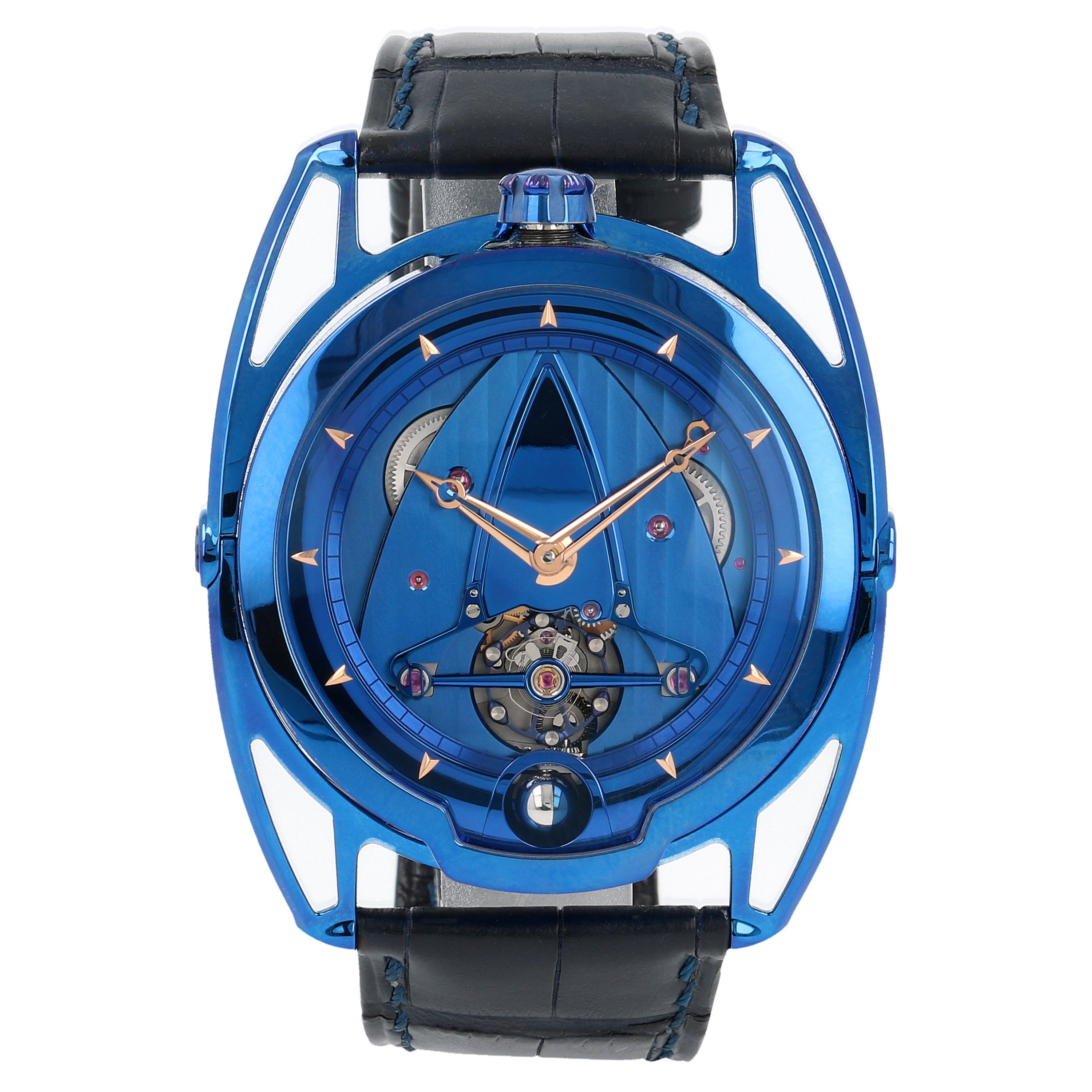
DB28
Model History
Presented in 2011, the DB28 is arguably the model that, more than any other, made De Bethune instantly recognizable. The case's proportions and the position of the crown, placed at 12 o'clock, recall the layout of nineteenth-century pocket watches, but the detail that turned it into an icon is the lug attachment: pivoting and fitted with internal springs, they are the full application, to an entire model, of the "floating lugs" patent De Bethune filed in 2006, designed to follow the wrist's movements and ensure a constant fit regardless of its shape.
Beneath the dial, the DB2115V4 caliber displays delta-shaped bridges with Côtes de Bethune decoration, a triple parachute shock-absorption system and, at 6 o'clock, the brand's patented spherical moon: here depicting Earth as seen from space, with hemispheres made of palladium and fire-blued steel, in an image the founders have said was inspired by Leonardo da Vinci's astronomical studies. The caseback shows the power reserve indicator, while a second indicator appears between 2 and 3 o'clock, dedicated to the self-regulating barrel's performance.
The DB28's success prompted De Bethune to turn it into a genuine family within the manufacture, with tourbillon, chronograph, skeletonized and color-themed variants such as the "Yellow Tones" series, as well as the DB28XP re-edition made in 2021 for the model's tenth anniversary, with a thinner case while keeping the original architecture intact.
Technical Specifications
Main Executions
Denis Flageollet summed up the philosophy behind the DB28 in a phrase that has become almost a brand motto: "don't do more, do better". It is therefore no surprise that the DB28's moon, rather than depicting our satellite as watchmaking tradition would have it, shows Earth as seen from space — a reversal of perspective that neatly reflects the manufacture's unconventional approach.