

DBS
Model History
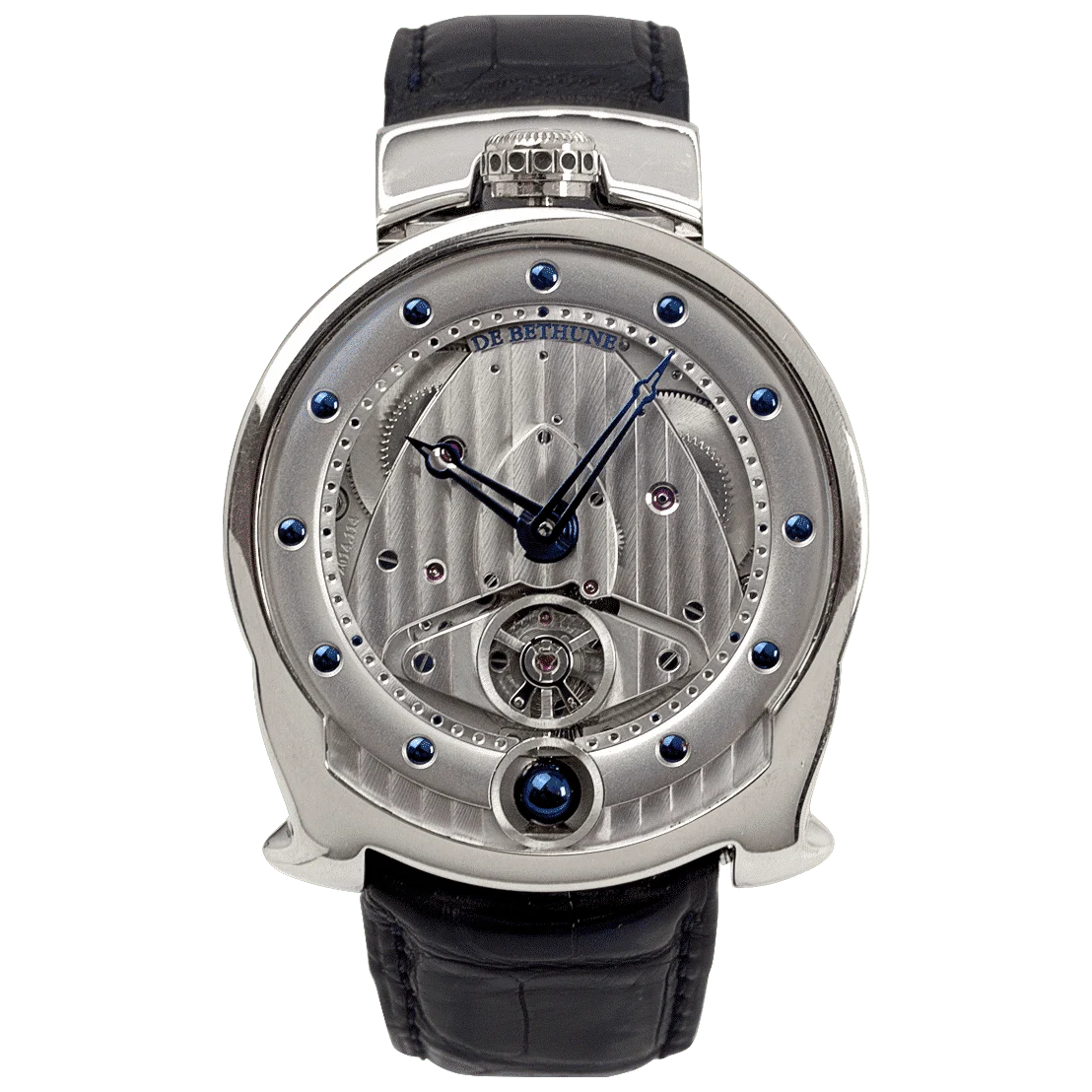
The DBS was born in 2005 as a one-off piece made for the Only Watch charity auction, at a time when De Bethune, founded just three years earlier, was still defining its aesthetic language. The result is one of the most unusual cases ever produced by the manufacture: a horseshoe shape, with De Bethune's typical ogival lugs on the lower part and the crown placed at 12 o'clock on an articulated arm, a solution that openly recalls pocket watches and anticipates by some years the layout of the more famous DB28.
What makes the DBS truly distinctive, however, is the absence of a traditional dial: it is the movement itself, based on the architecture of the caliber developed in 2004 for the DB15, that serves as the reading surface. At the center stands a highly unusual four-arm balance wheel, with titanium arms and elongated platinum oscillating masses, while the hour markers are obtained directly from titanium's fire-bluing. Completing the time display are the brand's patented spherical moon and, on the caseback, the power reserve indicator.
Born as an isolated experiment for charity, the DBS was later revisited in a small number of executions in platinum and gold, becoming a key passage in De Bethune's history: the first concrete demonstration that the movement, with its finishing and architecture, could replace the dial as the watch's true aesthetic protagonist.
Technical Specifications
Main Executions
Before becoming a proper collection, the DBS was, precisely, a single watch: a one-off piece donated to the Only Watch charity auction in 2005. Only the strong interest sparked by that unusual case convinced De Bethune to revisit its architecture for a small subsequent production run.