

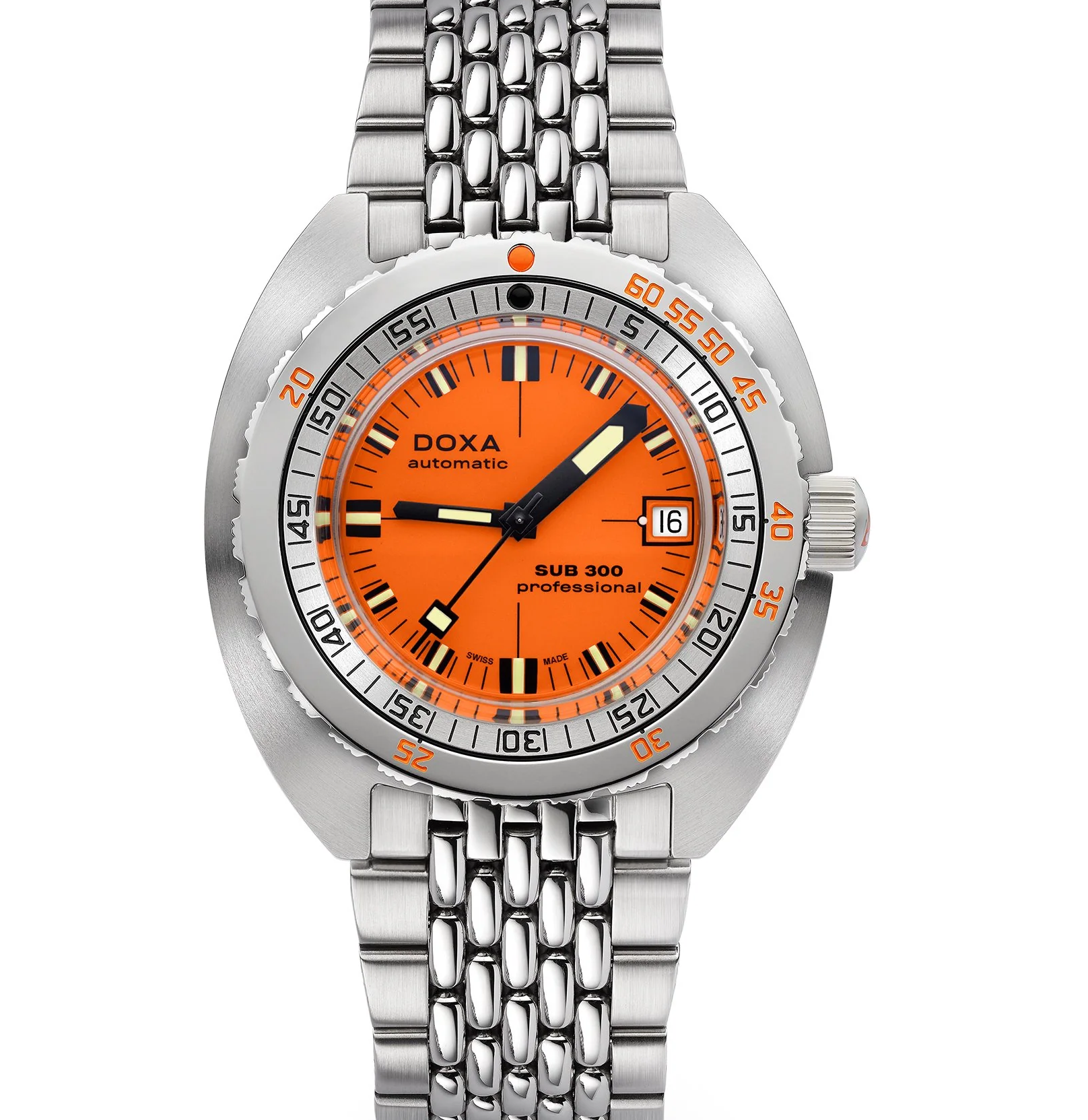
Model History
The SUB was born in 1967 from a very concrete question: which color remains visible longest underwater as light fades and the water turns murky? The answer came from Doxa product manager Urs Eschle and diver Claude Wesly, who ran tests in Lake Neuchâtel and identified orange as the shade with the best legibility while diving. The project was also developed with input from Jacques-Yves Cousteau's team, whose organization U.S. Divers initially handled distribution of the model in the United States. The result, presented in Basel in 1967, was the SUB 300: a cushion case, a unidirectional rotating bezel engraved with U.S. Navy no-decompression tables and, indeed, the first orange dial in watchmaking history — with the "300" in the name directly indicating the stated water resistance, 300 meters.
The following year brought the most significant technical development: the SUB 300T "Conquistador", among the very first commercial watches fitted with a helium escape valve, designed to stop the crystal from popping off during ascent from saturation dives. Between 1968 and 1975 the Swiss Army's combat diver corps adopted the SUB 300T Professional as standard issue, and the same model was supplied to some aquanauts of the U.S. Navy's SEALAB III mission in 1968. In the 1970s the SUB's fame was further cemented by Clive Cussler's novels, which turned it into the watch of his character Dirk Pitt, later also appearing on screen.
The quartz crisis put production in serious difficulty between the late 1970s and early 1980s, but the brand's revival under the Jenny family, from 1997, brought the SUB back to the center of the catalogue. Since then the line has expanded enormously in water-resistance depth and dial colors, while always staying true to the original layout: a cushion case, a bezel with no-decompression tables and, in most versions, that orange dial that remains the most recognizable trait of Doxa's entire production.
Technical Specifications
Main Executions
During the U.S. Navy's SEALAB III mission, in September 1968, at least twenty aquanauts were issued SUB 300T pieces: a rare operational endorsement for a civilian watch, which adds to the literary fame the model earned years later thanks to Clive Cussler's novels, where the orange SUB becomes the signature of adventurer Dirk Pitt, later also brought to the screen in films such as "Sahara" (2005).