

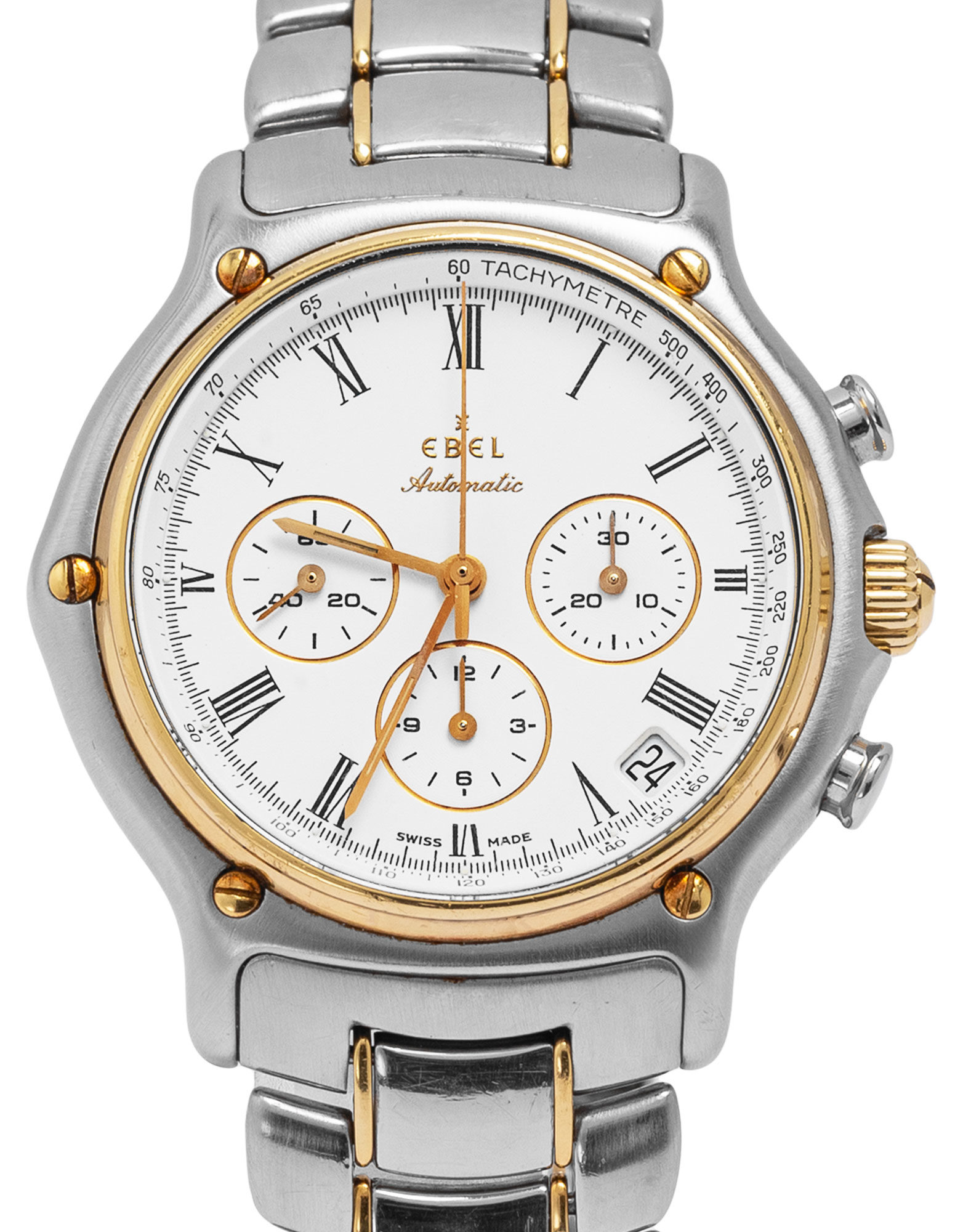
1911
Line History
The 1911 line was born in 1986, for the brand's 75th anniversary, as a direct tribute to the year Eugène Blum and Alice Lévy founded the La Chaux-de-Fonds atelier. Unlike other Ebel collections, the name does not describe a case shape or a function, but explicitly recalls the brand's birth date, at a time — the second half of the 1980s — when Ebel, under the leadership of Pierre-Alain Blum, was decisively building its identity as "Architects of Time".
From its earliest versions the 1911 inherits from the Sport Classic the hexagonal-profile case and the "wave"-motif link bracelet, but reinterprets them in a more formal language, designed for both men's watches and women's executions with mother-of-pearl dials and diamond indices. In the early 2000s the brand relaunched the line with the "1911 BTR" (Back to the Roots) series, fitted with in-house manufacture calibers certified as COSC chronometers, underlining the intent to bring attention back to the mechanical component after years of production oriented mainly toward quartz.
In its more recent versions the 1911 has expanded to include chronographs, a Worldtimer model displaying all 24 time zones, and various case sizes, from the 30 mm of the women's executions up to the 44 mm of the men's chronograph versions, confirming itself as the collection that, more than any other, explicitly tells the story and birth year of the brand.
Technical Specifications
Main Executions
The link bracelet introduced with the 1911 became so sought after, for its build quality and comfort on the wrist, that according to several industry sources it sometimes ended up worth more than the watch it was paired with.