

Model History
The Scafograf was born in the late 1950s as Eberhard & Co.'s answer to the then-emerging category of professional dive watches, a segment in which the brand found itself competing directly with names like Rolex, Blancpain and Omega. The first Scafograf 100, produced in an extremely limited run around 1958, was followed the very next year by a version rated resistant to a depth of 200 meters: considerable figures for the time, achieved thanks to the experience Eberhard had gained as a supplier of cases and movements for other brands in the industry.
The early examples, compact in diameter and without a rotating bezel, were soon joined by a second generation fitted with a rotating bezel and better crown protection. It is, however, the 1964 version, with the case enlarged to 42 mm, baton hands and linear indices, that is considered by collectors to be the most complete and iconic form of the Scafograf: a model that reached a stated water resistance of 300 meters, while later variants in the family went on to reach 400, 750 and even 1,000 meters.
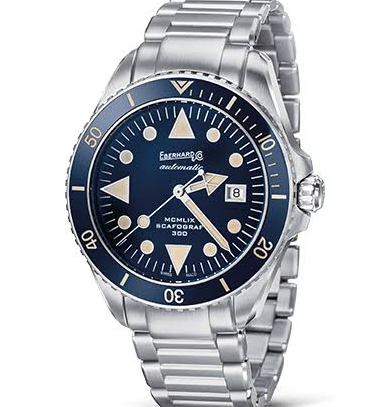
In 2016 Eberhard & Co. brought the Scafograf back to the center of its catalogue with the revival of the Scafograf 300 (reference 41034), which directly reprises the aesthetics of the 1964 version in a 43 mm steel case, with an automatic ETA 2824-2 base movement and a helium escape valve: an explicit bridge between the brand's historic diving heritage and its contemporary audience.
Technical Specifications
Main Executions
Before becoming known mainly as a chronograph brand, Eberhard & Co. was for decades also an important supplier of cases and movements on behalf of other watch brands: a technical experience rarely told to the wider public, but one that directly contributed to the brand's ability to compete, with the Scafograf, on ground then dominated by giants like Rolex and Omega.