

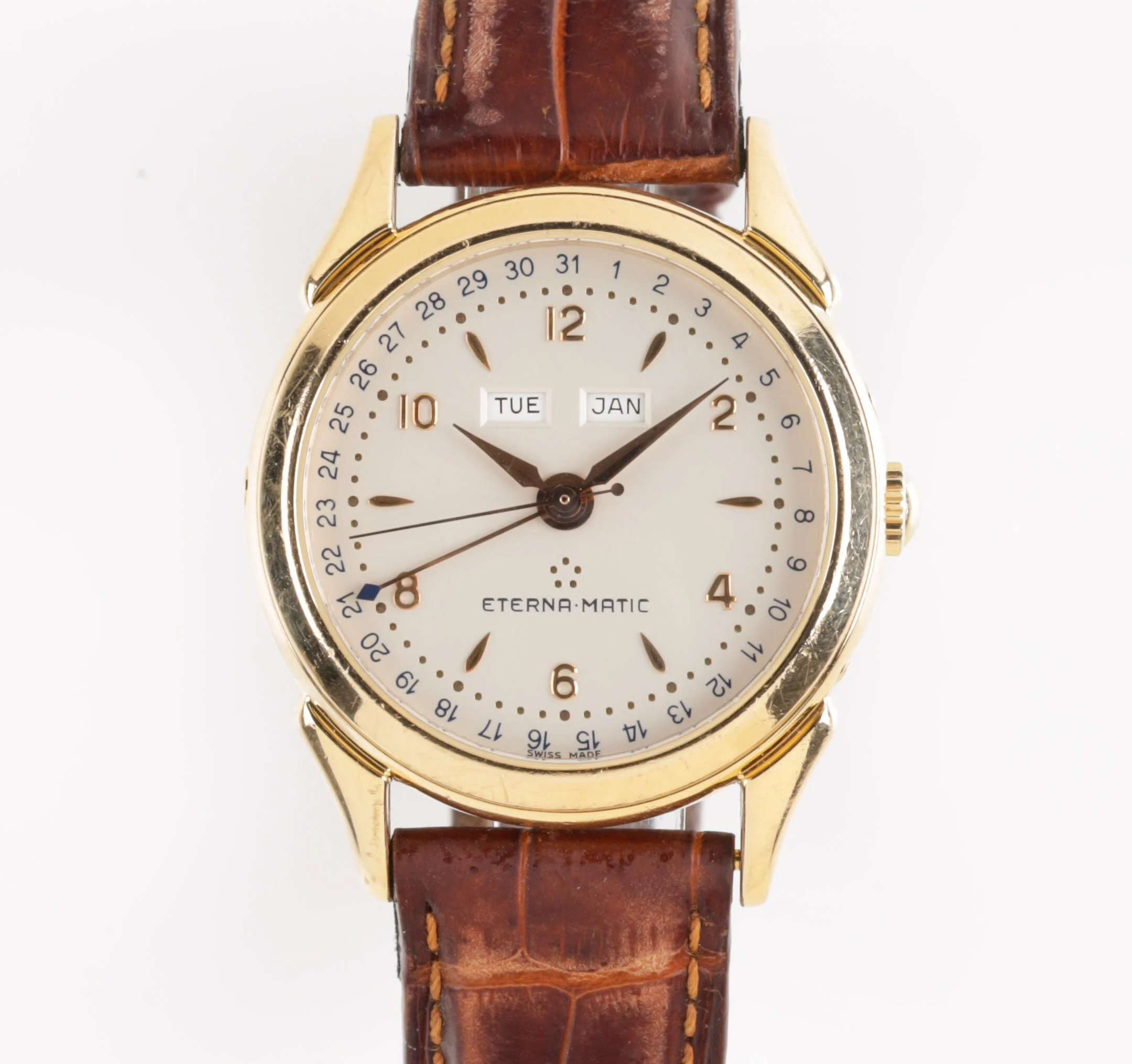
Eterna-Matic
Line History
In 1948 Eterna presented the Eterna-matic, an automatic caliber in which the rotor no longer turned on a friction system, as had been customary until then, but was instead supported by five tiny ball bearings. The solution drastically reduced friction and wear in the winding mechanism, improving precision and long-term durability: an innovation developed in Grenchen that, within a few years, was adopted — through licenses and variants — by much of the Swiss watch industry as the new construction reference for automatic movements.
Around this caliber the Eterna-Matic line was born, and in the following decades it went on to house some of the most significant references in the brand's catalogue: in 1956, to mark the company's centenary, the extremely thin Centenaire sub-line with its hidden crown; in 1962 the Eterna-Matic 3000 Dato, presented at the time as the thinnest men's automatic watch available with a date function. The line thus spans both dress models and sturdier executions, united by the same ball-bearing rotor construction principle.
The Eterna-Matic name is still today the one with which the brand identifies its family of automatic watches, produced over time both with in-house calibers — such as the Calibre 39 presented in 2013, the result of five years of internal development — and on mechanical bases from third-party suppliers. The five aligned balls of the company logo, adopted in 1948 itself, continue to point directly to the invention that made Eterna a name known well beyond the boundaries of its Grenchen manufacture.
Technical Specifications
Main Executions
The name of the movement manufacturer ETA SA, still today among the largest caliber suppliers in the Swiss watch industry, is a contraction of "Eterna" itself: it was born in 1932, when movement production was split off from watches bearing the Eterna name.