

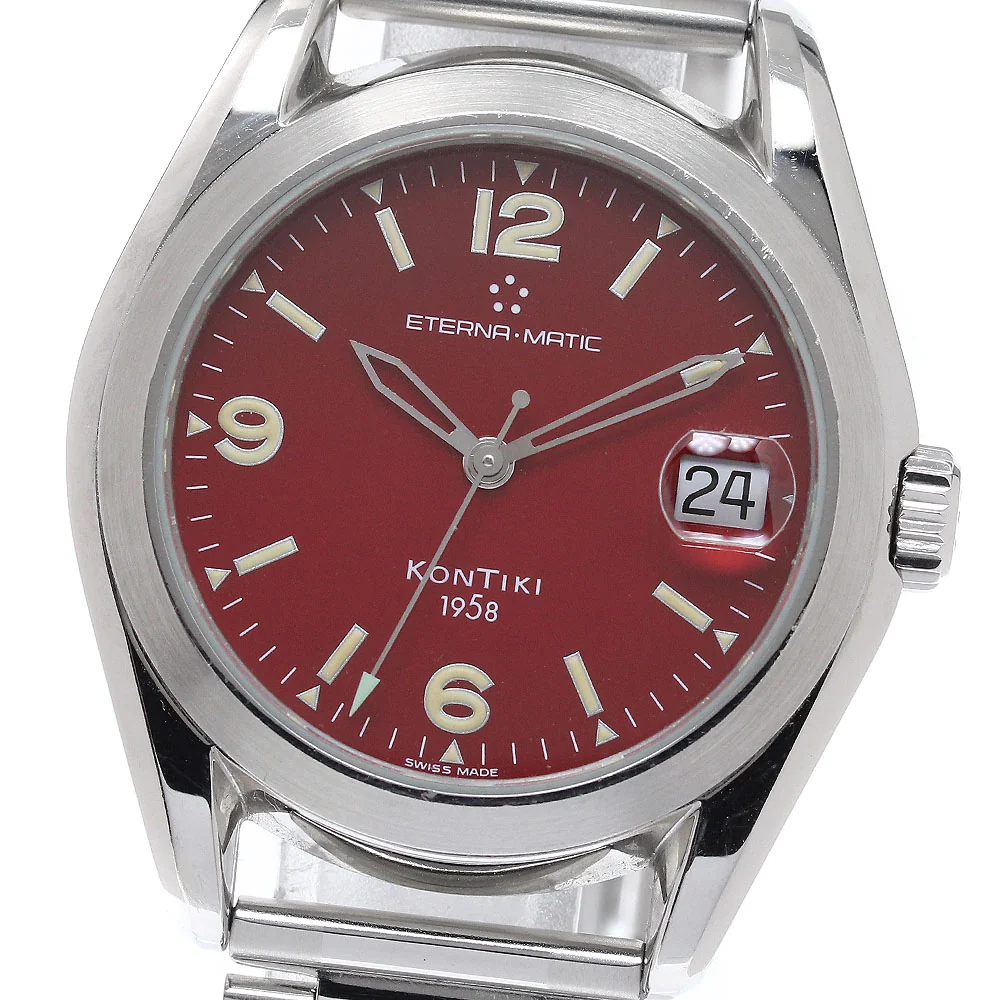
Line History
In 1947 Norwegian explorer Thor Heyerdahl crossed the Pacific Ocean on a balsa-wood raft, the Kon-Tiki, to demonstrate the possibility of a pre-Columbian migration from South America to Polynesia: 101 days at sea, roughly 8,000 km from Callao, Peru, to the Polynesian islands. During the crossing some crew members wore Eterna watches, which passed the test by proving highly resistant to salt water and to the open ocean's temperature swings. The expedition became an international story, helped by the documentary "Kon-Tiki," which won the Academy Award in 1951.
In 1958 Eterna paid tribute to the feat by launching the Kon-Tiki line: a rugged dive watch with an automatic movement and a stated water resistance of up to 200 meters, its case back engraved with a depiction of the raft — replaced, from 1960, by a solid gold medallion. From the start, the name tied the brand to an imagery of adventure and ocean exploration, clearly setting this collection apart from Eterna's more formal catalogue of the era.
In the following decades the line branched into numerous variants — from the Kon-Tiki 20 to the tougher Super Kon-Tiki, through to women's versions such as the Lady Kon-Tiki and contemporary reissues like the Kon-Tiki Bronze Diver — while maintaining an underlying continuity made of a rugged case, strong water resistance and dive-watch aesthetics. The Kon-Tiki remains today one of the brand's most recognizable and longest-running collections.
Technical Specifications
Main Executions
The 1950 documentary "Kon-Tiki," telling the story of Thor Heyerdahl's expedition, won the Academy Award for Best Documentary Feature in 1951: a milestone that helped make the feat internationally famous and, by extension, the name of the Eterna watches that had accompanied it.