

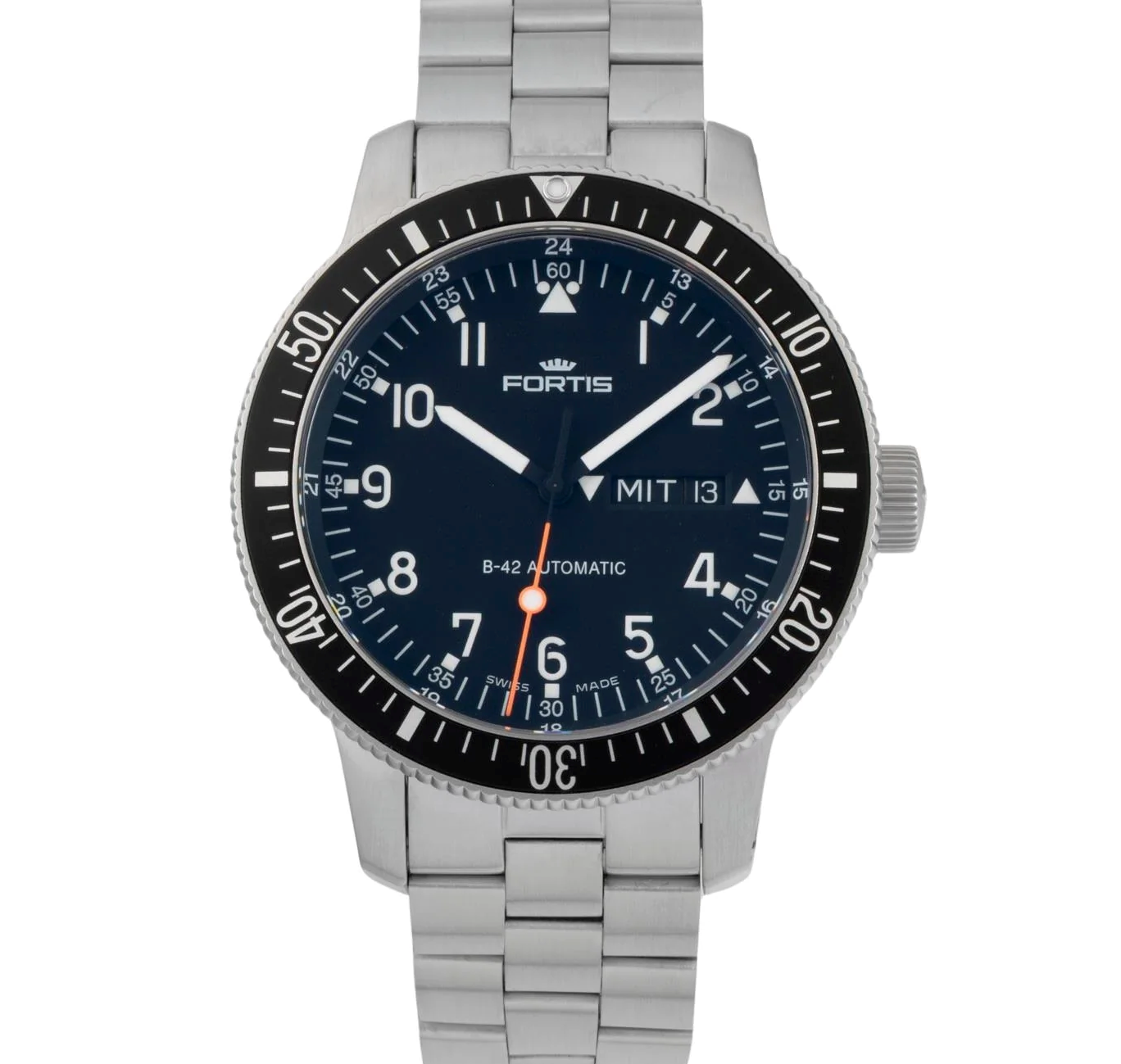
B-42
Line History
Introduced in Basel between 2000 and 2001, the B-42 was born as an evolution of the Flieger line and takes its name directly from the B-Uhr tradition, the German observation watches of the Second World War to which the "B" refers, combined with the new case's 42 mm diameter. Compared with the classic Flieger models, the B-42 introduced a more modern, square-cut case with cylindrical sides and a clearly distinct rotating bezel, designed to remain legible and easy to operate even in difficult operating conditions.
The project also marked an important technical milestone for the brand, with the development of the F-2001 calibre, among the first movements with a base built in-house by Fortis rather than bought entirely from a third-party supplier. Thanks to its modular design, the B-42 case became, over the course of the 2000s, the common platform for most of the brand's instrument-watch catalogue: from 2003 it housed the updated version of the Official Cosmonauts Chronograph, but over time it also gave rise to diving variants, day/date versions, and executions with added complications such as a mechanical alarm, the result of a collaboration with independent watchmaker Paul Gerber, who in 1998 had developed for Fortis one of the world's first automatic chronographs fitted with a mechanical alarm.
With the brand's repositioning under its new ownership from 2018, the name B-42 stopped being the catalogue's dominant designation, replaced by more specific lines such as Flieger, Marinemaster and Novonaut; it nonetheless remains a key chapter in the brand's history, since it was thanks to this very case that the Official Cosmonauts Chronograph took on the proportions with which it is most commonly associated by the public today.
Technical Specifications
Main Executions
The name B-42 became so identifiable that for years, in enthusiasts' language, "B-42" ended up denoting not a single model but an entire family of Fortis cases and references: a rare case in which the name of a technical case platform came, in common usage, to outshine the names of the lines it housed.