

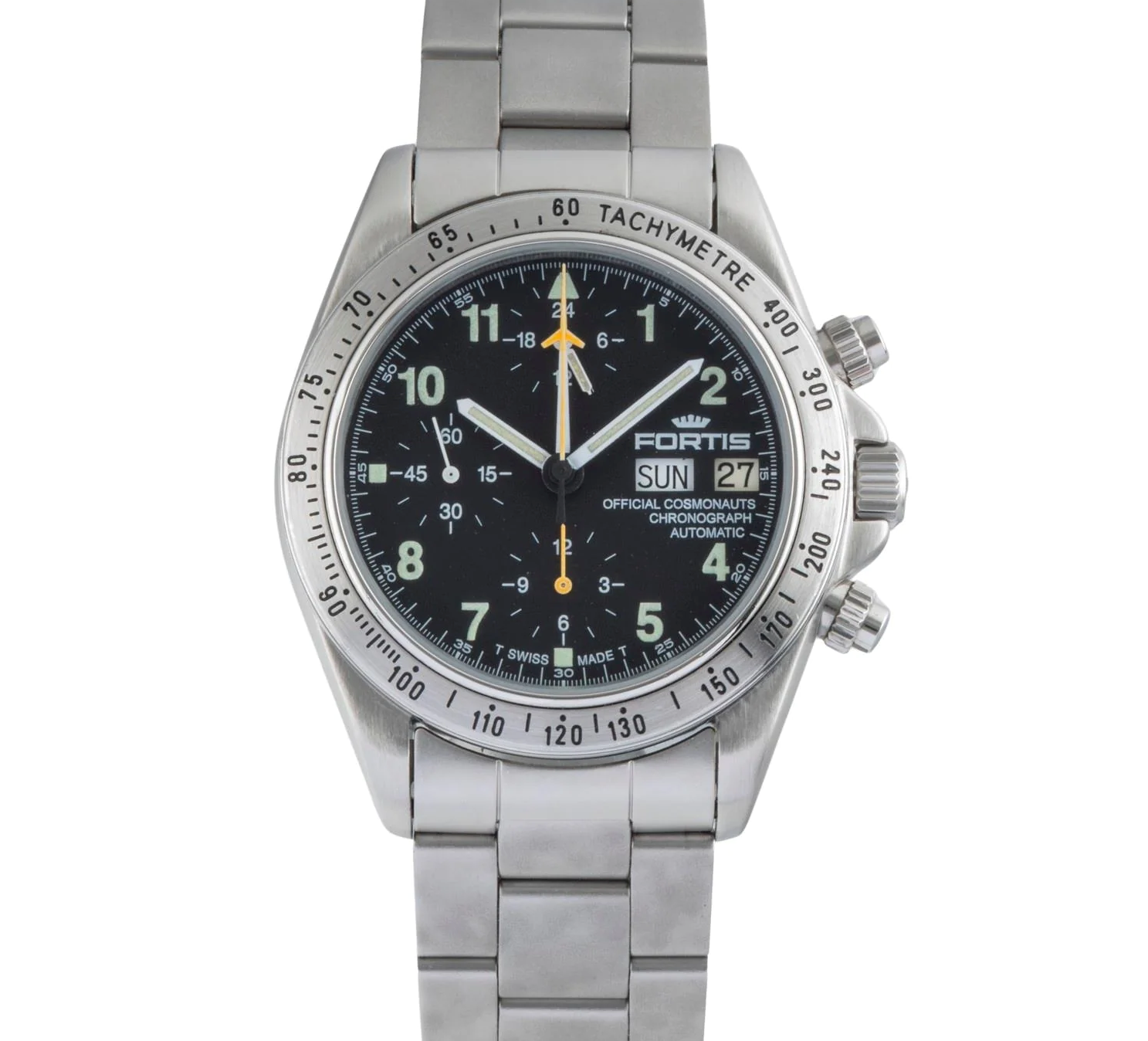
Official Cosmonauts Chronograph
Line History
The line was born in the early 1990s, when Fortis embarked on a long certification process with the Russian space agency to develop an automatic chronograph able to function reliably in space, where quartz watches — used until then by Western space programs precisely for their mechanical simplicity — posed different constraints than an automatic movement. The watch, based on a robust automatic chronograph calibre from the Valjoux/ETA 7750 family, was subjected to extreme tests: pressure close to absolute vacuum, thermal swings and accelerations of up to 12 G, to verify that its mechanics could withstand both launch and time spent in orbit.
In 1994 the decisive test took place with German astronaut Ulf Merbold, who during the Euromir mission wore the Fortis chronograph for thirty days aboard the MIR station, using it during daily physical training and various medical experiments: the watch passed the test without failure. From that moment the Fortis Official Cosmonauts Chronograph became part of the standard equipment issued to cosmonauts before launch from the Yuri Gagarin training center in Star City, near Moscow, earning the title — claimed by the brand — of official watch of the Russian space program. The earliest references were fitted with fluorescent orange chronograph hands and tritium-treated indices, designed to remain legible under the artificial lighting conditions of the orbiting station.
Over the course of the 1990s and 2000s the chronograph accompanied numerous Soviet and Russian missions to the MIR station first, then to the International Space Station, accumulating — according to various trade publications — more actual hours of use in space than any other wrist chronograph. In 2003 the line was updated with the adoption of the 42 mm B-42 case, also designed to be operated more easily with the pressurized gloves of spacesuits, keeping the automatic chronograph calibre but updating it to the more modern ETA 7750.
After the 2018 change of ownership, the new management led by Jupp Philipp explicitly relaunched the brand's cosmonaut heritage: in 2023 the Novonaut debuted, powered by the proprietary Werk 17 calibre developed and tested in collaboration with the Swedish Space Corporation up to the stratosphere, while in 2024 a special version of the Novonaut was produced as the official watch of the Austrian Space Forum's AMADEE-24 Mars simulation mission, confirming that the bond between Fortis and space exploration, born with the Cosmonauts line, remains at the heart of the brand's identity today.
Technical Specifications
Main Executions
For certification, Fortis subjected the chronograph to tests simulating near-vacuum conditions and accelerations up to 12 times the force of gravity: a test bench designed to prove that, contrary to Western assumptions at the time, an automatic movement (not just quartz) could also function reliably in space. The fluorescent orange chronograph hands, still a recognizable trait of the line today, were chosen precisely to remain legible under the artificial light of orbiting environments.