

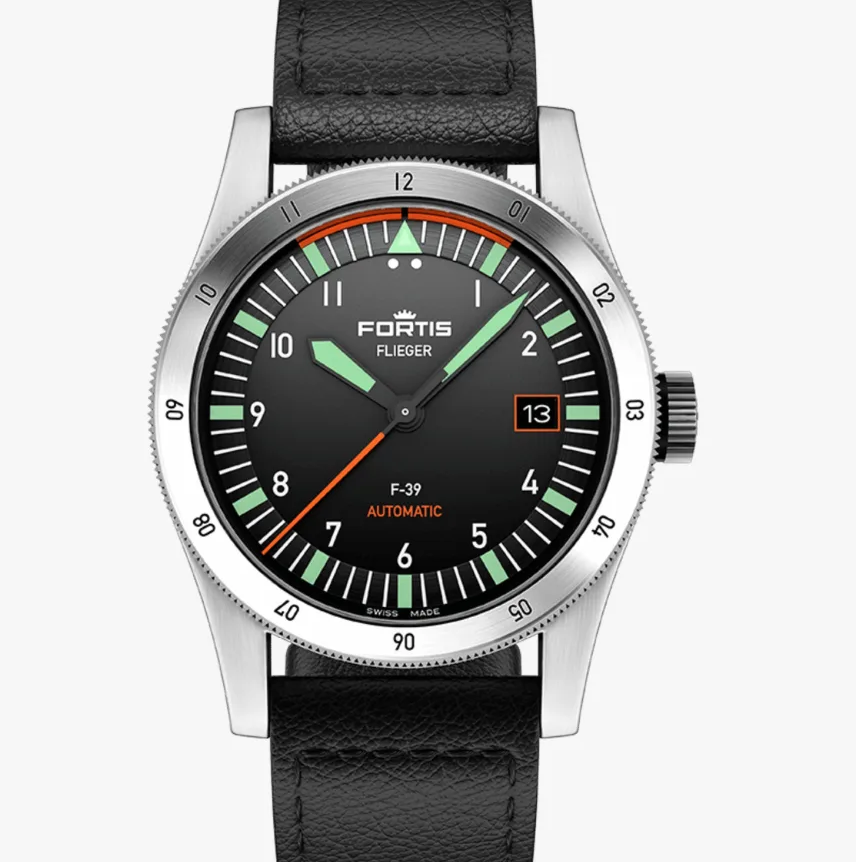
Flieger
Line History
Fortis's bond with aviation dates back to 1929, when British journalist Lady Grace Drummond-Hay wore an automatic Fortis-Harwood watch during the first round-the-world flight made aboard an airship, the Zeppelin LZ 127: a feat that, according to the brand's own account, helped draw founder Walter Vogt toward the world of flight. It would take until 1987, however, the year of the company's 75th anniversary, for this bond to take the shape of a dedicated line: thus came the Sky-watch, a quartz chronograph soon followed by an automatic version, which set in motion what would become the modern Flieger family.
The line's aesthetic draws openly on the Beobachtungsuhren ("B-Uhr"), the large observation watches made for the German Luftwaffe during the Second World War: high-contrast dials with large Arabic numerals, sword hands clearly visible even with flight gloves on, and the characteristic oversized "onion" crown, originally designed to be operated without removing gloves in the cockpit.
In 2020 the line underwent a thorough restyling by Swiss designer Xavier Perrenoud, with pilot and flight expert Marc Rollier as the project's public face: this gave rise to the Flieger F-39, offered in a more compact 39 mm case that echoes the proportions of the historic observation models. In 2025 the line gained two new editions with the proprietary Werk 7 calibre, produced in a limited series of 100 pieces each, confirming the continuity of a project begun almost four decades earlier.
Technical Specifications
Main Executions
"Flieger" simply means "aviator" in German: a straightforward name, in keeping with the tradition of military observation watches, which favoured function over form. The oversized crown, today an almost decorative signature element, was in fact born from a very practical need: letting pilots set the time without removing their gloves in an unpressurized, often freezing cockpit.