

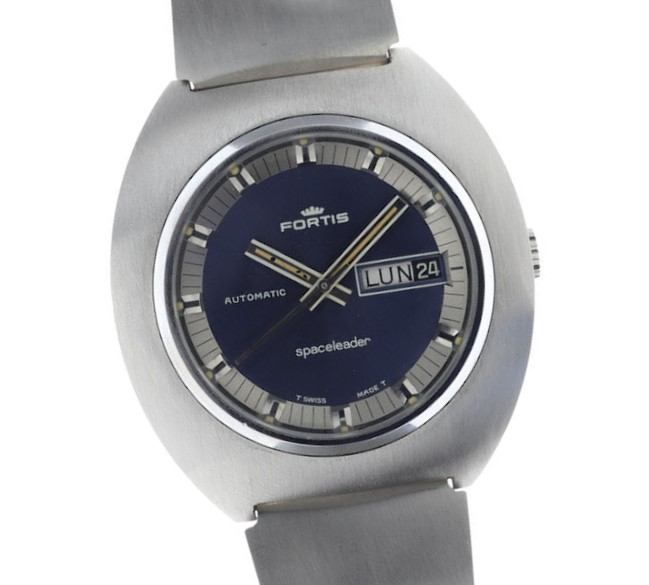
Spaceleader
Line History
The Spaceleader was born in the first half of the 1970s, a period when the imagery of the space race permeated not only popular culture but also industrial design, watchmaking included: the name itself, evocative of an era fascinated by orbital exploration, fits within the trajectory that a few years earlier had seen Fortis present the Spacematic to astronauts of NASA's Gemini program, although the Spaceleader did not share with that model any actual use in real space missions.
From a technical and aesthetic standpoint, the Spaceleader stands out for its modular steel case design, with chromed elements and a solid steel bracelet integrated into the case, following the bold, square-cut formal language typical of the era. The automatic ETA calibre 2789 movement, produced between 1969 and 1976, places the model's production with reasonable confidence in the first half of the decade; the dial, available in various colours — silver, blue, gold-plated and, more rarely in the first generation, a vivid orange — is often characterized by a large date window, an element that became one of the line's most recognizable features.
Unlike the Cosmonauts line, which emerged from a technical certification process for actual use in space, the Spaceleader remains chiefly a product of design and period taste, aimed at a broader audience tied to the fashions of the time rather than to instrumental use: for this very reason, the model is appreciated by collectors today mainly as a record of Fortis's "space age" aesthetic of the 1970s, rather than as a technical forerunner of the brand's space chronographs.
Technical Specifications
Main Executions
Despite never having left the Earth's atmosphere, the Spaceleader carries in its name the same space-age imagery that, a few years later, with the Official Cosmonauts Chronograph, would become a certified technical reality for Fortis: a curious case where marketing anticipated, almost by chance, the history the brand would go on to write in space for real.