

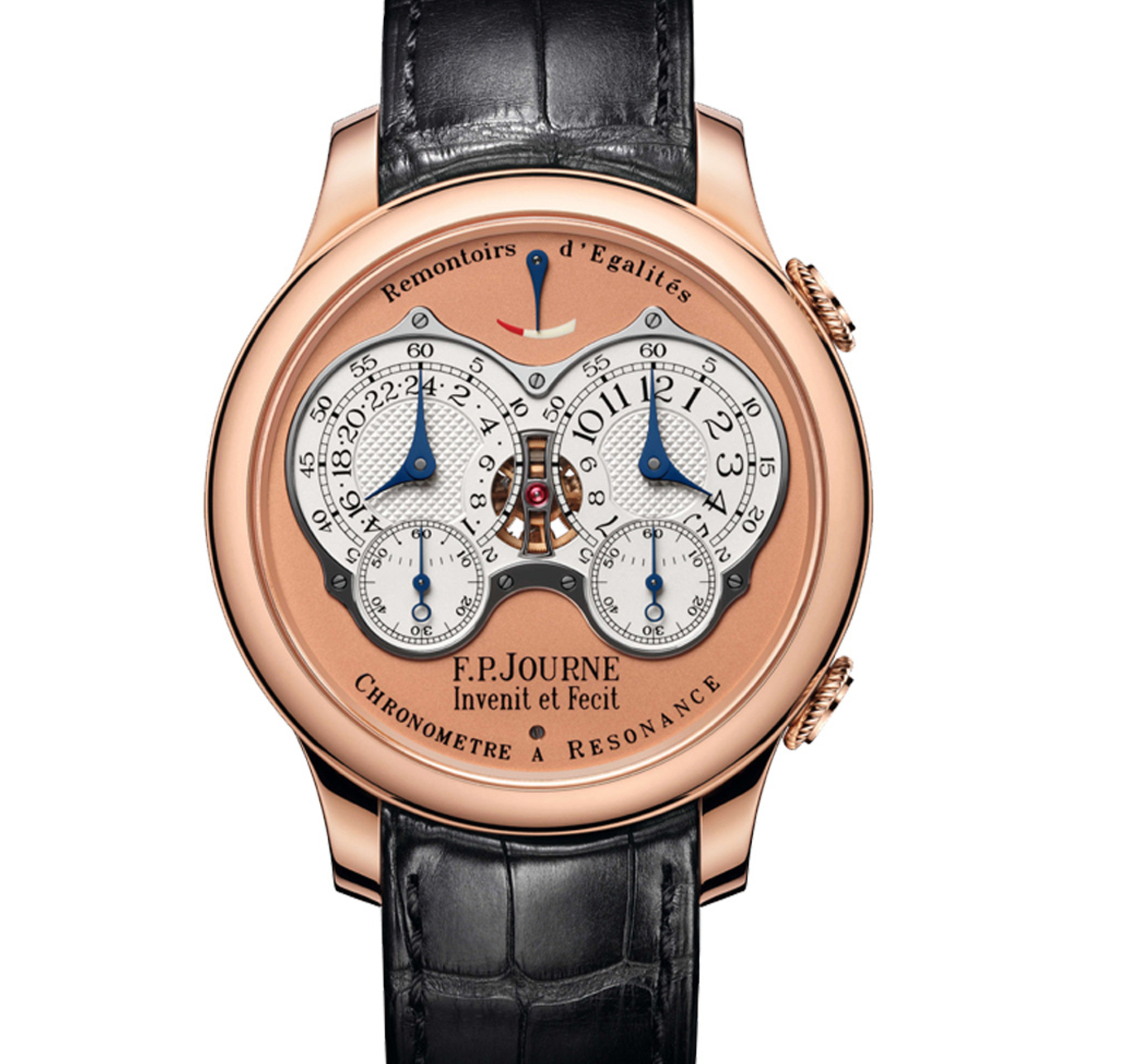
Chronomètre à Résonance
Collection History
Resonance is a physical phenomenon already observed by Abraham-Louis Breguet in the early nineteenth century in his double-movement pocket watches, but no one had ever managed to make it work reliably in a wristwatch. François-Paul Journe, who had begun studying the principle back in 1983 by building himself a first pocket-watch example, finally managed to miniaturize it in 2000, when he presented the Chronomètre à Résonance as one of the first models from his newly founded manufacture.
At the heart of the caliber are two independent balance wheels, mounted very close together on the same mainplate: the tiny vibrations transmitted through the movement's structure gradually bring them to oscillate in sync, staying within a few seconds of each other. The first series (2000-2003) used 38 mm platinum cases and rhodium-plated brass movements; from 2004 Journe switched to 18-carat red gold movements, in line with the construction style that would become the Maison's trademark, also expanding the available diameters.
In 2020 the collection was renewed with caliber 1520, which introduces a single barrel with differential distribution of motive torque and two separate crowns for winding and zeroing the seconds: a deep technical reworking that confirms the Résonance as one of the most celebrated technical manifestos of contemporary independent watchmaking.
Technical Specifications
Main Executions
Journe has recounted that it took him nearly twenty years, from his first experiments in 1983 to the commercial launch in 2000, to bring resonance from the workbench to the wrist: a challenge he himself has described as won above all through courage and sheer persistence.