
F.P. Journe
Brand History
François-Paul Journe was born in Marseille in 1957. A restless boy, at fourteen he was sent to a technical boarding school, and in 1976 he graduated from the Paris watchmaking school. It was there that his real training began: for eight years he worked in the antique-watch restoration workshop of his uncle Michel Journe in Paris, where he studied closely the mechanisms of the great masters of the past, particularly Abraham-Louis Breguet and Antide Janvier, and formed his first relationships with collectors and historic houses. During these formative years he also carried out prestigious commissions for Asprey of London — including, at just twenty-two, the design of a planetarium, and later a "Sympathique" clock inspired by Breguet — and for Cartier, honing a craft in which restoration, historical research and technical invention constantly intertwined.
In 1983 Journe began seriously studying the phenomenon of resonance between balance wheels, already observed by Breguet and Janvier two centuries earlier, and built himself a first resonance pocket watch: an almost stubborn exercise that he himself would later recall as a daily battle won above all through sheer persistence. It would take years more before that principle could be finally miniaturized into a wristwatch. In the meantime, to finance the launch of his own manufacture, in 1999 Journe launched the "Souscription Tourbillon": twenty platinum pocket tourbillons, sold in advance to twenty clients and collector friends — including his friend Camille Berthet, who first suggested the formula — whose deposits provided the capital needed to found, also in 1999 in Geneva, the company Montres Journe SA. The wristwatch collection was presented that same year at the Basel fair, under the Latin motto that would become the brand's signature: "Invenit et Fecit", meaning "he invented it and he made it".
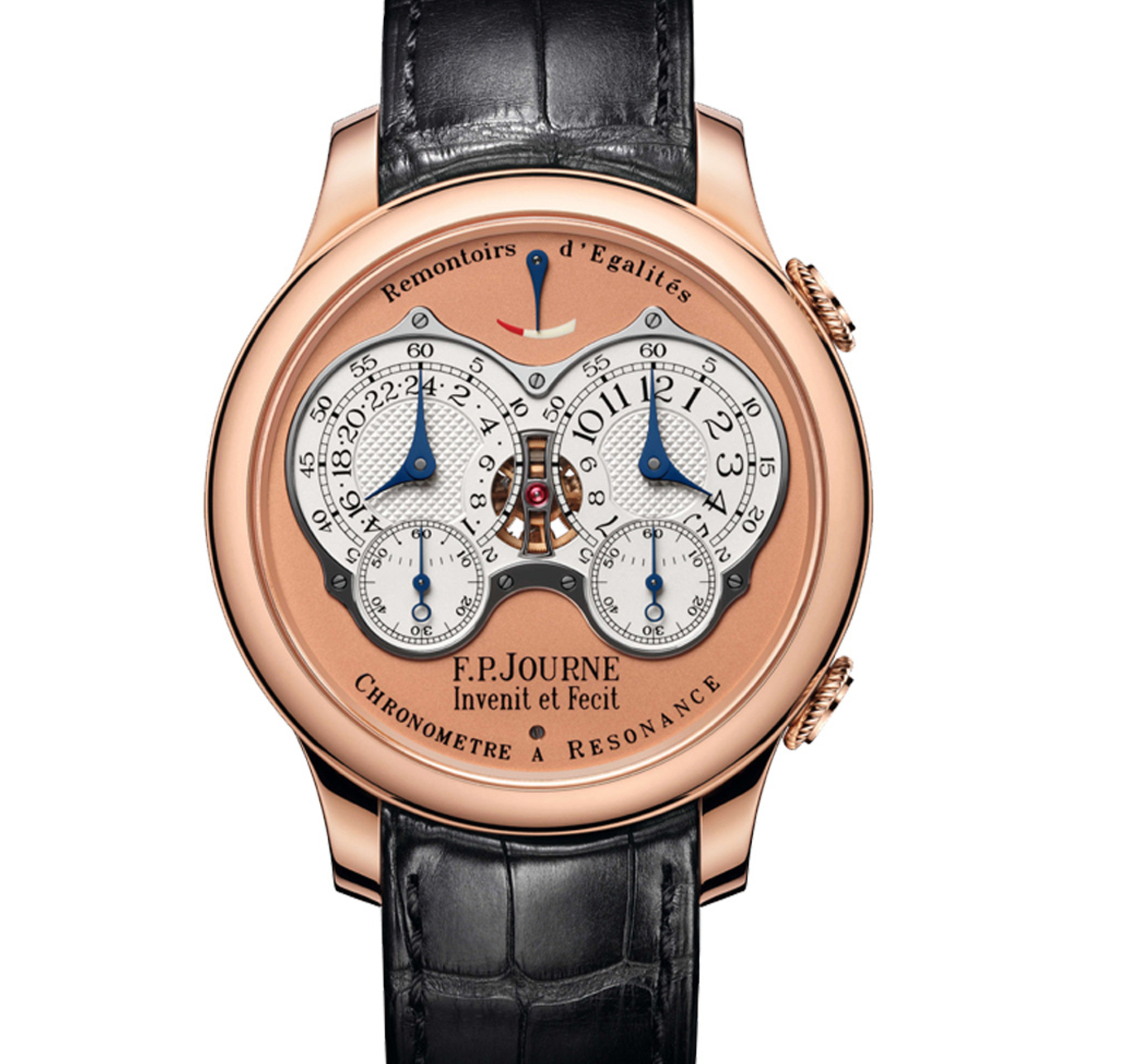
The following decade marked the brand's technical consecration: in 2000 came the Chronomètre à Résonance, the first wristwatch in history to harness acoustic resonance between two independent balance wheels; in 2001 the Octa caliber debuted, the Maison's first automatic movement and the base for much of its subsequent production. Boutiques opened in Tokyo (2003), Hong Kong (2006) and finally Geneva (2007), while between 2004 and 2008 F.P. Journe won the Grand Prix d'Horlogerie de Genève in the Aiguille d'Or category three times, a record unmatched among independent brands. Over time the brand built an almost complete vertical supply chain, with subsidiaries Les Boîtiers de Genève for cases and Les Cadraniers de Genève for dials. In 2018 Chanel acquired a minority stake of around 20% in the company, without affecting Journe's creative control, as he remains at the helm of the manufacture — today housed in a former gasworks in the heart of Geneva and capable of producing just under a thousand watches a year.