

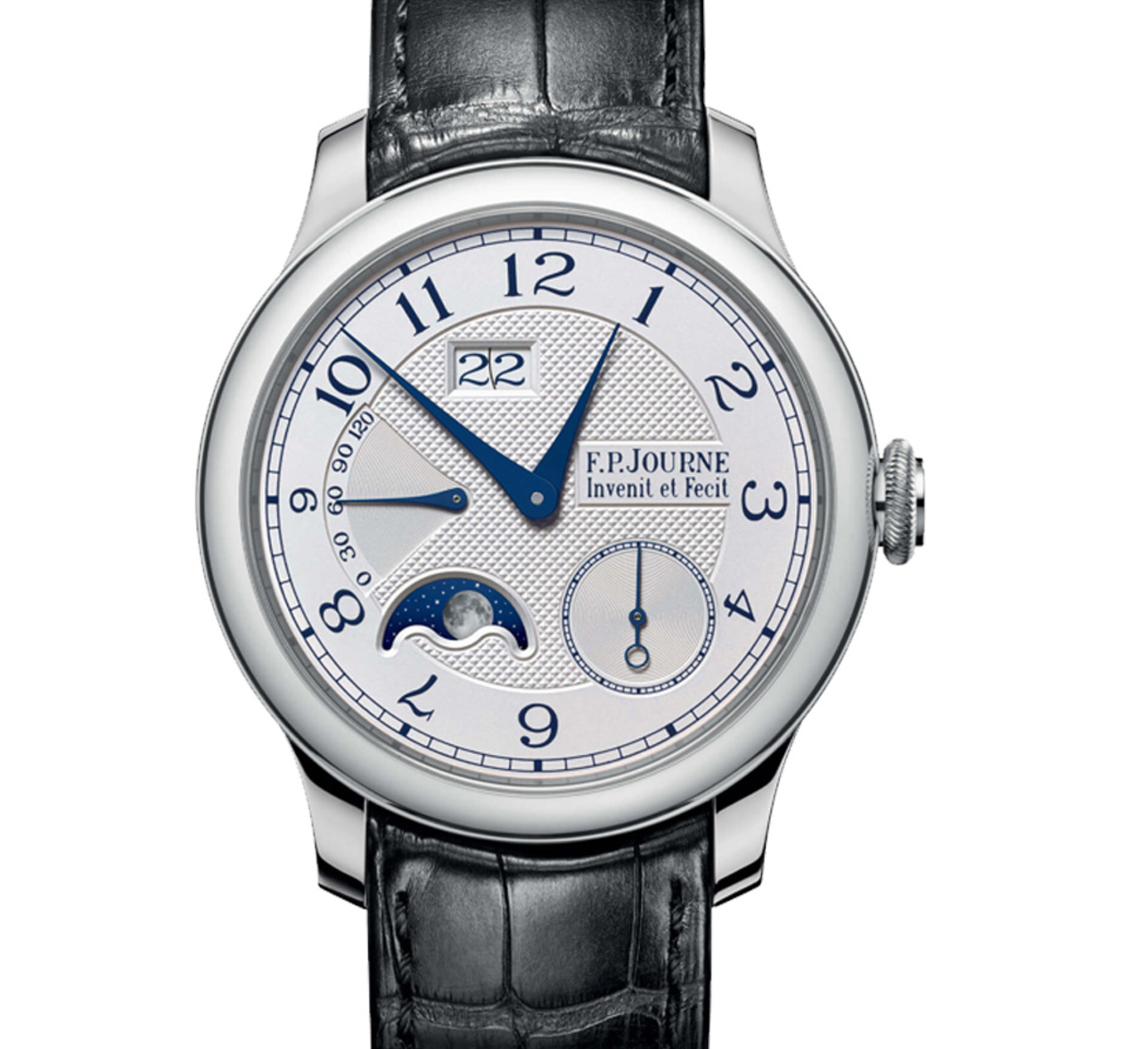
Octa Automatique Lune
Collection History
In 2001 François-Paul Journe presented caliber 1300, the third movement from his young manufacture and its first with automatic winding: a project conceived, unlike his first two manual calibers, to reach a wider audience without giving up the technical rigor that had already defined the tourbillon and the resonance. From that caliber the Octa family was born, which over the years has become the base for nearly all of the brand's automatic watches.
The rotor, made of 22-carat gold and deliberately offset, leaves room on the movement for the addition of further complications: date, moon phases, dual time zone, chronograph. Thanks to a barrel with an extremely long mainspring — about a meter long, barely a millimeter thick — the Octa guarantees roughly seven days of overall autonomy, five of which are fully guaranteed to chronometric precision, an unusually long autonomy for an automatic movement of its time.
The moon-phase execution, the Octa Automatique Lune, applies this technical base to one of the complications most loved by collectors, pairing the moon-phase display with the robustness and long power reserve of caliber 1300: a balance between romantic complication and everyday reliability that well sums up the philosophy of the entire Octa collection.
Technical Specifications
Main Executions
Caliber 1300 was the manufacture's third movement overall, after the resonance tourbillon and the Résonance's caliber: over the years, more than a dozen different variants of the Octa family have been derived from that single technical base.