

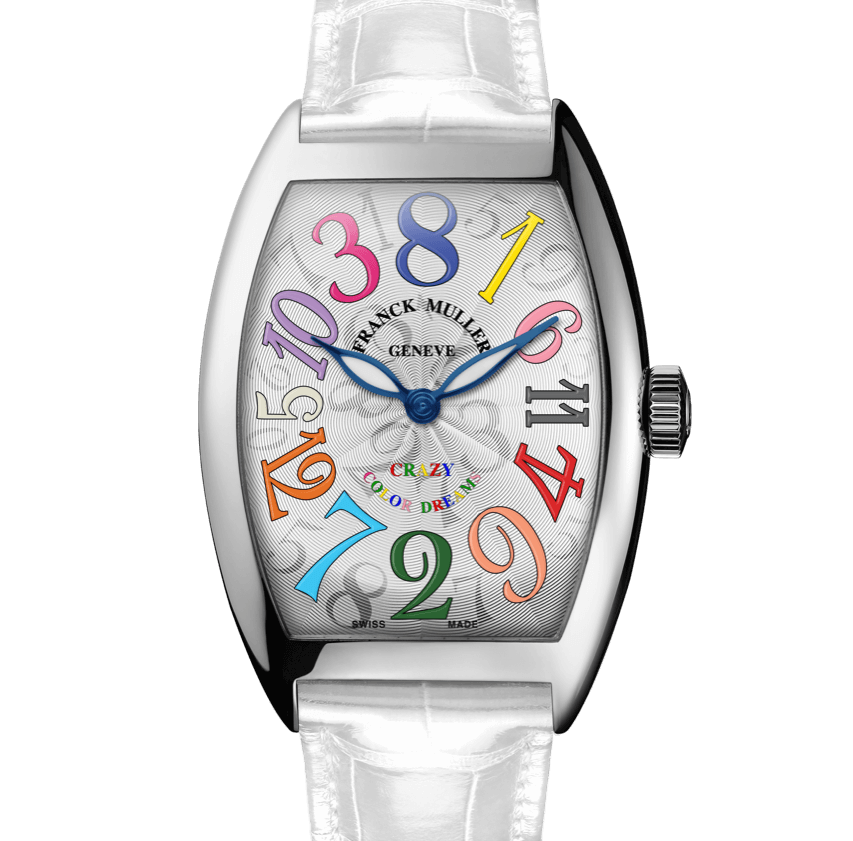
Crazy Hours
Line History
The idea for the Crazy Hours was born, as Franck Muller himself has recounted, during a vacation in Mauritius: from there came the project for a watch in which the hours no longer follow one another in order, but "jump" from one number to another in a deliberately disorienting sequence. The model was presented in 2003 and quickly became one of the brand's most instantly recognizable symbols, able to translate into a concrete mechanism the philosophy Franck Muller himself declared: "I found a way to deconstruct and reconstruct time."
From a technical standpoint, the Crazy Hours is based on a jumping-hour module paired with an automatic movement: the hour hand makes a jump of roughly 150 degrees at the end of each hour to reach the next figure in the non-linear sequence, while the minute hand continues its traditional path around the dial's 60 minutes. The result is a dial where the numbers do not occupy their usual hourly positions, yet remain perfectly legible once the logic of the mechanism is understood.
Originally created on the Cintrée Curvex case, the Crazy Hours module has over the years also been offered on other lines in the catalog, notably on the sportier Vanguard, and has been produced in numerous dial, material and color variants, including skeletonized and women's versions set with diamonds. In 2018 the brand celebrated the line's fifteenth anniversary with a dedicated special edition, confirming its importance in the Franck Muller catalog alongside the Cintrée Curvex itself.
Technical Specifications
Main Executions
Despite the visual effect, on the Crazy Hours dial the numbers stay fixed in their respective positions: it is only the hour hand that "jumps" from one figure to the next following the non-linear sequence, while the entire mechanism continues to measure time with perfect regularity beneath the dial's seemingly disordered surface.