

Airman
Model History
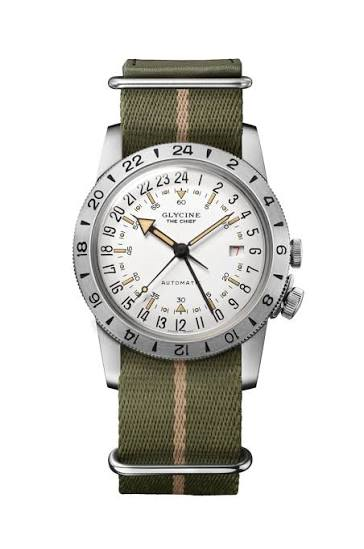
The Airman was born in 1953 out of a very concrete need: a Glycine employee who was also a pilot, Samuel Glur, flagged to the company the difficulty pilots had in keeping track of multiple time zones during long-haul flights. The answer was a watch with a 24-hour dial (instead of the usual 12) and a rotating bezel also graduated over 24 hours, fitted with a locking device to prevent accidental movement: by turning the bezel and reading where the hand meets the outer scale, the pilot could read a second time zone without calculations. Glycine is among the first Swiss brands to bring this solution to market, anticipating by a short margin other 24-hour bezels introduced by competing brands in the immediately following years.
The Airman's success grew both in civilian circles, as the expansion of intercontinental flights made dual time reading useful, and in military and aviation circles: several industry sources recount US pilots who chose it as their personal watch during the Vietnam conflict, although this specific anecdote circulates mainly through journalistic and collector accounts, without unambiguous official archival documentation — a detail therefore worth treating with due caution. More solid, since it is also repeated by encyclopedic sources, is the episode linking the Airman to space: astronaut Pete Conrad wore it during the Gemini 5 (1965) and Gemini 11 (1966) missions, an episode often cited as one of the first outings of an automatic watch beyond Earth's atmosphere.
Over the years Glycine has declined the Airman into numerous variants: from the 1967 Airman SST, with a barrel-shaped case and orange dial inspired by the aesthetic of supersonic aircraft, to the faithful Airman No. 1 re-edition, which in the 2010s brought the original 36 mm case back into production. Today the family includes more modern executions with larger diameters, but the technical principle of the 24-hour dial and bezel remains the trait that has identified the model since its birth.
Technical Specifications
Main Executions
The Airman precedes the launch of the famous Rolex GMT-Master (1954) by about a year, making Glycine, according to several industry sources, the first Swiss brand to bring to market a wristwatch with a rotating bezel graduated over 24 hours specifically designed for reading a second time zone.