

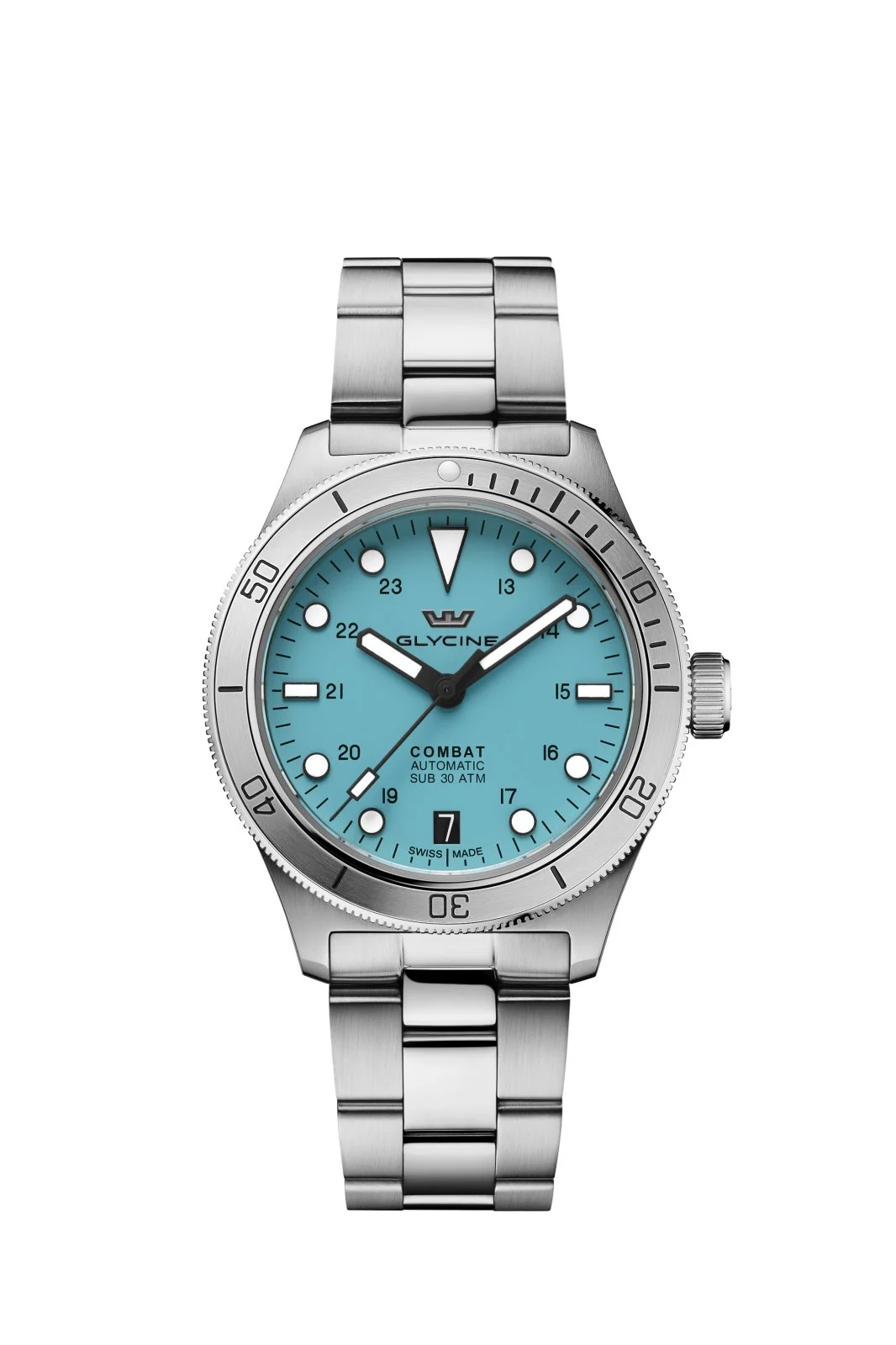
Combat
Model History
If the Airman was born to meet the needs of pilots, the Combat was launched in 1967 as a counterpart designed for a more earthbound military and outdoor use: a sturdy, legible, resilient watch, aimed at those operating in the field rather than in the cockpit. The first executions featured matte black dials with highly legible Arabic numerals, an internal 24-hour scale and watertight "compressor"-type cases, made in collaboration with EPSA, a specialized supplier that in those same years produced similar cases for several Swiss tool watches.
The Combat kept a lower profile than the Airman for years, while still remaining in production with several variants oriented toward the military and outdoor world. It is mainly from the early 2000s onward that the brand more decisively developed its diving potential, giving rise to the Combat Sub: an evolution that combines the original military aesthetic — dark dial, prominent crown, case ruggedness — with the technical specifications of a professional dive watch, with graduated unidirectional bezels and high water resistance.
Today the Combat family includes several variations — including Sub executions more oriented toward diving, Field executions closer to a field-watch setup, and vintage-style re-editions that recall the original 1967 design — while maintaining a common identity: that of a watch designed above all for toughness and legibility in difficult conditions, complementary to the Airman's aeronautical calling.
Technical Specifications
Main Executions
The watertight "compressor" cases of the first Combat executions, supplied by EPSA, were a technology shared with other Swiss tool watches of the era: the same technical know-how Glycine would draw on decades later to develop the Sea Kraken, inspired by a rare dive watch from the brand of the same generation.