

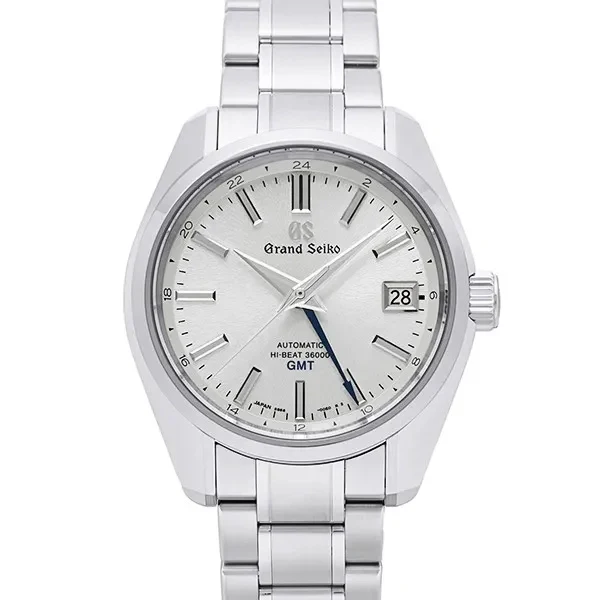
Heritage Collection
Line History
The Heritage Collection was not born as just another line in the catalog, but as a direct reinterpretation of the model that invented Grand Seiko's aesthetic language: the 1967 44GS, produced at the Daini Seikosha plant in Kameido. In those years Seiko was chasing a world record for precision; but in terms of design the catalog remained fragmented, with European-inspired round cases barely distinguishable from one another. Designer Taro Tanaka, after months spent watching customers at the Wako boutique in Ginza as they chose a watch, identified a counterintuitive fact: models with faceted cases and mirror-polished surfaces sold better, even though the catalog as a whole lacked a shared grammar. From this observation came the 44GS and, with it, a true rulebook of design principles that Seiko would apply for decades to come.
The rules, informally known as the "nine enduring elements of Grand Seiko style," called for flat, two-dimensional case surfaces rather than curved ones, crisp and unbroken facet edges, hands and indexes with mirror faces free of the slightest optical distortion, and a dial designed to maximize legibility in any light. To achieve those perfectly flat mirror surfaces — impossible to produce with standard machine polishing — Seiko's artisans developed a hand-finishing technique on large rotating tin wheels, named "Zaratsu" after the German Sallaz grinding wheel whose name was adapted into Japanese: a slow, almost entirely manual process requiring years of apprenticeship, still entrusted today to a small number of master polishers. A year after the 44GS, in 1968, the same design philosophy was applied to the 62GS, Grand Seiko's first high-frequency automatic (36,000 vibrations per hour) and the first without a bezel, with the crown moved to 4 o'clock for an even cleaner profile.
The quartz crisis of the 1970s abruptly halted mechanical production of these models, and for roughly two decades the Grammar of Design survived only in vintage pieces kept by collectors. Its return to production — starting in 1998 with the new mechanical caliber 9S55, and then, in increasingly faithful form from the 2010s onward with the reissued SBGW and SBGH series dedicated explicitly to the 44GS and the 62GS — allowed Grand Seiko to reconnect its direct present with that single 1967 prototype. It is no coincidence that, when the brand became independent from Seiko in 2017, the Heritage Collection was chosen as one of the founding collections of the new chapter, precisely because it embodies the recognized stylistic origin of all subsequent production, including more modern collections such as Evolution 9.
Today the Heritage Collection sits alongside more recent lines but remains, in the brand's official communications, the historical and philological point of reference: the cases stay faithful to the original 1967-68 proportions (with a few diameter variants for different wrists), the movements are manual or automatic calibers from the 9S family, and every visible surface continues to be finished with the Zaratsu technique passed down from generation to generation. It is the collection in which, more than anywhere else, Grand Seiko asserts its own aesthetic independence from the Swiss watchmaking it set out to match in the 1960s.
Technical Specifications
Main Executions
The name "Zaratsu" is the almost phonetic Japanese transcription of the German Sallaz brand of grinding wheels used for this polishing technique: a linguistic detail that illustrates well how, as early as the 1960s, Grand Seiko imported Western tools and references only to transform them into a wholly original craft method, today claimed as one of the brand's most recognizable signatures.