

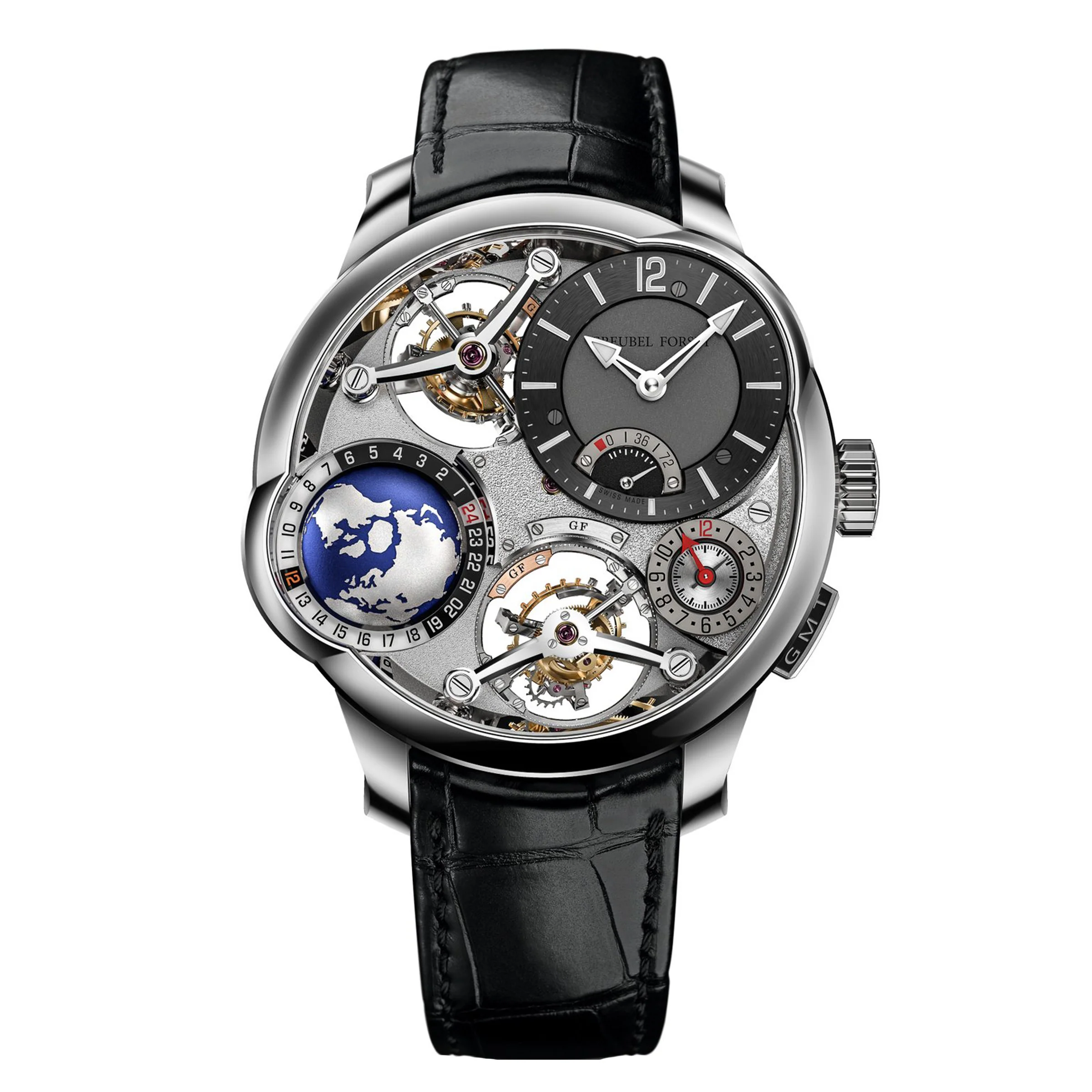
Quadruple Tourbillon
Line History
The Quadruple Tourbillon was born of the same obsession that drove the Double Tourbillon 30°: making the tourbillon, invented by Abraham-Louis Breguet in 1801 for pocket watches that were essentially stationary, genuinely effective on a wristwatch in constant motion. The mechanism was patented by Greubel Forsey in 2004 and presented to the public in 2005, reaching the market a few years later in a first execution in red gold in 2009: from the outset it was described as one of the most complex mechanical architectures ever built into a series-produced wristwatch.
The underlying idea is to push the principle of cross-compensation to its extreme: instead of a single tourbillon, or two cages as in the Double Tourbillon 30°, the caliber employs four tourbillons arranged in two pairs, each enclosed in its own double system of tilted cages. The two pairs are then linked to each other by a spherical differential, a gear that averages the mean speed of the two tourbillon pairs exactly as an automotive differential averages the rotation of a car's wheels: the result is a rate accuracy averaged across a far wider range of positional combinations than any single or double tourbillon.
Over the years the line has been offered in platinum and in all-black versions, as well as the 2018 Quadruple Tourbillon Blue variant with a polished blue gold dial, and it has given rise to a direct lineage of more recent models such as the GMT Quadruple Tourbillon, which combines the same four cages with a second time zone featuring a rotating globe — confirmation of how central this invention has remained to the manufacture's technical language even years after its debut.
Technical Specifications
Main Executions
The spherical differential that averages the two tourbillon pairs works on the same logic as a car's differential, which lets the two drive wheels turn at different speeds through a curve: Greubel Forsey applies the same mechanical principle, on a millimeter scale, to average the rate of four independent regulating organs within a single wristwatch.