

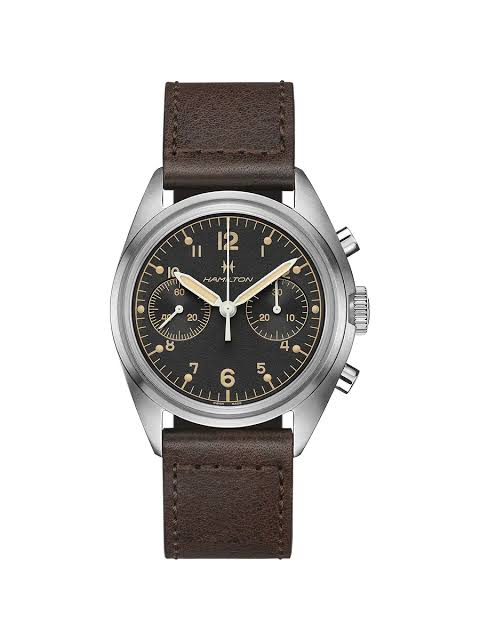
Khaki Aviation Pilot Pioneer
Line History
Hamilton's bond with aviation began early: as far back as 1918 the brand was entrusted with timing the first flights of the US airmail service, a service that required instruments just as reliable as those used on the railroads. During the 1930s this relationship grew even stronger, with Hamilton becoming the official timekeeper for some of the leading American airlines of the era, forging an aviation identity alongside its already solid railroad one.
During the Second World War this know-how flowed into wartime production: among the instruments supplied to the armed forces were the Model 23 pocket chronometer and other cockpit instruments for pilots and navigators, designed for extreme legibility and to withstand the harsh conditions of military cockpits. It is precisely this visual language — essential, functional, high-contrast — that the modern Khaki Aviation collection reinterprets.
The Pilot Pioneer, in particular, takes a contemporary approach to the aesthetic of wartime cockpit instruments: a textured black canvas dial, cathedral hands with cream-colored "faux patina" Super-LumiNova (an aging effect achieved without radioactive materials, unlike historical dials) and an automatic H-10 movement with an antimagnetic Nivachron hairspring and 80 hours of power reserve. The collection also includes a 33 mm manual-wind version with a one-piece strap, with proportions closer to the original vintage models.
Technical Specifications
Main Executions
The name "Pioneer" explicitly recalls the pioneering pilots who, in the 1910s and 1930s, entrusted their safety to cockpit instruments also timed by Hamilton: the cream-colored faux patina on the lume, now widespread across many vintage-inspired watches in the industry, is a stylistic device that imitates the natural yellowing of the radium once used on period hands, without using its radioactive component.