

Pan Europ
Line History
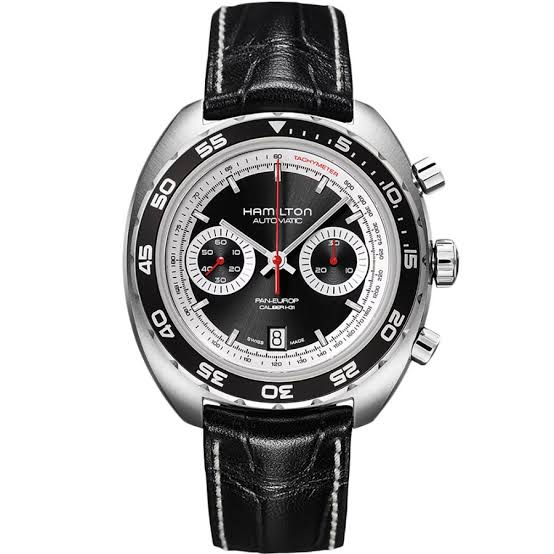
The Pan Europ debuted in 1971, at the height of an era of bold, geometric watch design. Its "cushion"-shaped case, with the crown positioned at 9 o'clock and the pushers at 2 and 4, was not an isolated styling choice: it was the same layout adopted in those years by other automatic chronographs such as the Heuer Autavia and the Breitling Chrono-Matic, because they all shared the same mechanical heart, Caliber 11 — the world's first automatic chronograph movement, developed in a 1969 technical race by the "Chronomatic" consortium formed by Heuer, Breitling and Hamilton itself, with a contribution from module supplier Dubois-Dépraz.
The name "Pan Europ" echoed the aspiration toward a unified European market typical of that era, and placing Hamilton in this technical race alongside the great Swiss names of the automatic chronograph marked an important symbolic turning point: it was precisely during that period that the brand was progressively moving away from its American manufacturing roots, with the closure of the Lancaster plant in 1969 and its sale to SSIH (later absorbed into the Swatch Group) in 1974.
The model long remained a semi-forgotten chapter of Hamilton's history, until its 2014 reissue: the new version, included in the American Classic collection, dropped the chronograph complication in favor of a simpler three-hand automatic, powered by the H-30 caliber (based on the ETA 2824), but kept intact the distinctive traits of the cushion case and the off-center crown at 9 o'clock as a vintage stylistic signature. In more recent years Hamilton has also paired this version with limited editions that more faithfully recover the chronograph function of the original Pan Europ.
Technical Specifications
Main Executions
The unusual position of the crown at 9 o'clock — rather than on the right side of the case as usual — is not an isolated styling choice by Hamilton, but a direct legacy of the layout of Caliber 11, the movement developed jointly with Heuer and Breitling: the same detail can in fact also be found on the Heuer Autavia and the Breitling Chrono-Matic of the same period.