

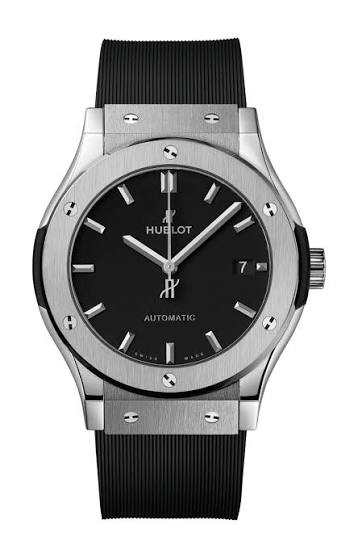
Classic Fusion
Line History
The Classic Fusion debuted at the Basel fair in 2010, five years after the launch of the Big Bang that had relaunched the brand under Jean-Claude Biver's leadership. The new line was born as a refined, slimmed-down version of the Big Bang aesthetic: the same round case with an exposed bezel fixed by six decorative H-shaped screws, but with more restrained proportions, clean dials and a decidedly slimmer profile, designed for an audience seeking formal elegance rather than the sporty, eye-catching character of the chronograph that preceded it.
The name itself, "Classic Fusion," states the line's intent: to be the spiritual heir of the original 1980 Classic — Hublot's first watch, which had introduced the pairing of a gold case with a natural rubber strap — reinterpreted, however, with the construction techniques and materials developed by Hublot in the following decade, from ceramic to titanium to King Gold, the brand's proprietary rose gold alloy enriched with platinum to keep a more intense tone over time compared to traditional rose gold.
Over the years the Classic Fusion has branched into several sub-lines: the base three-hand version, the Chronograph, the Aerofusion (with skeletonized dials and, in some variants, moon phases) and the collaboration with French artist Richard Orlinski, which applies a faceted treatment inspired by his geometric sculptures to the case. In 2020, for the brand's fortieth anniversary, Hublot presented the Classic Fusion Original, a 45 mm case conceived as a direct and more faithful tribute to the 1980 Classic.
Technical Specifications
Main Executions
Despite its name evoking a direct continuity with the past, the Classic Fusion was historically born as a simplified offshoot of the Big Bang, not as an uninterrupted continuation of the original 1980 Classic: it is only with later editions, such as the fortieth-anniversary Original, that the link to the brand's first watch is made explicit in the design.