

MP Collection
Collection History
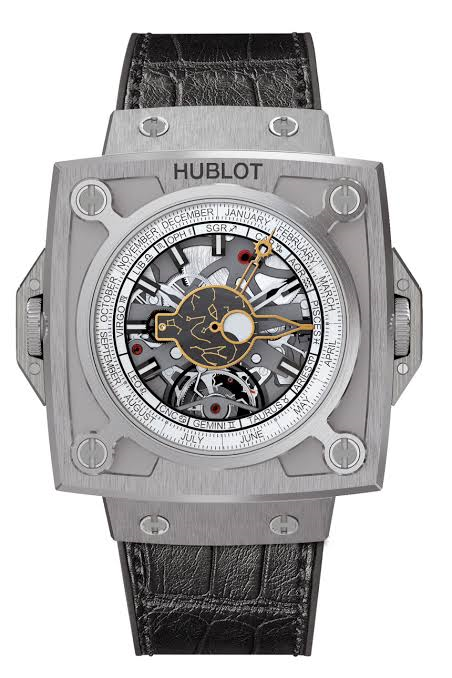
The MP Collection — where the initials stand for "Masterpiece" — debuted in January 2011, entrusted to a dedicated team of watchmakers, engineers and designers brought together internally by Hublot under the name "Confrérie Horlogère." Jean-Claude Biver described its goal with a formula that became famous: "more watchmaking, more mastery, more innovation." Unlike the other lines in the catalog, the MP Collection does not aim at commercial accessibility but at pushing watchmaking engineering to its limits, with unprecedented complications, record power reserves and unconventional aesthetic solutions.
The numbering of the models, from MP-01 onward, does not follow a chronological order but the order in which individual projects were completed, which explains why a higher number sometimes reaches the market before a lower one. Among the most significant milestones are the MP-01 (2011), a barrel-shaped-case chronograph with a ten-day power reserve achieved thanks to three consecutive barrels, and above all the MP-05 "LaFerrari" (2013), developed in collaboration with Ferrari: eleven stacked barrels power a caliber that Hublot presents with a declared record of fifty days of power reserve, while time is read on rotating drums instead of traditional hands.
The research continued with the MP-11 (2018), which packs a fourteen-day power reserve, spread across seven vertical barrels, into a case of contained thickness for a watch of this complexity. More recently the collection has also opened up to artistic collaborations: the MP-15 (2023), created with Japanese artist Takashi Murakami, introduces the first series-produced central flying tourbillon in a twelve-petal flower-shaped case, while the MP-16 and MP-17, developed with artist Daniel Arsham, reinterpret the reading of time in a sculptural, fluid, almost liquid way.
Technical Specifications
Main Executions
On the MP-05 "LaFerrari," to achieve the declared record of fifty days of power reserve, Hublot replaced the traditional hands with rotating drums that move along linear indications: the result looks more like a car's odometer than a watch dial, a choice consistent with the collaboration that gave rise to the project.