

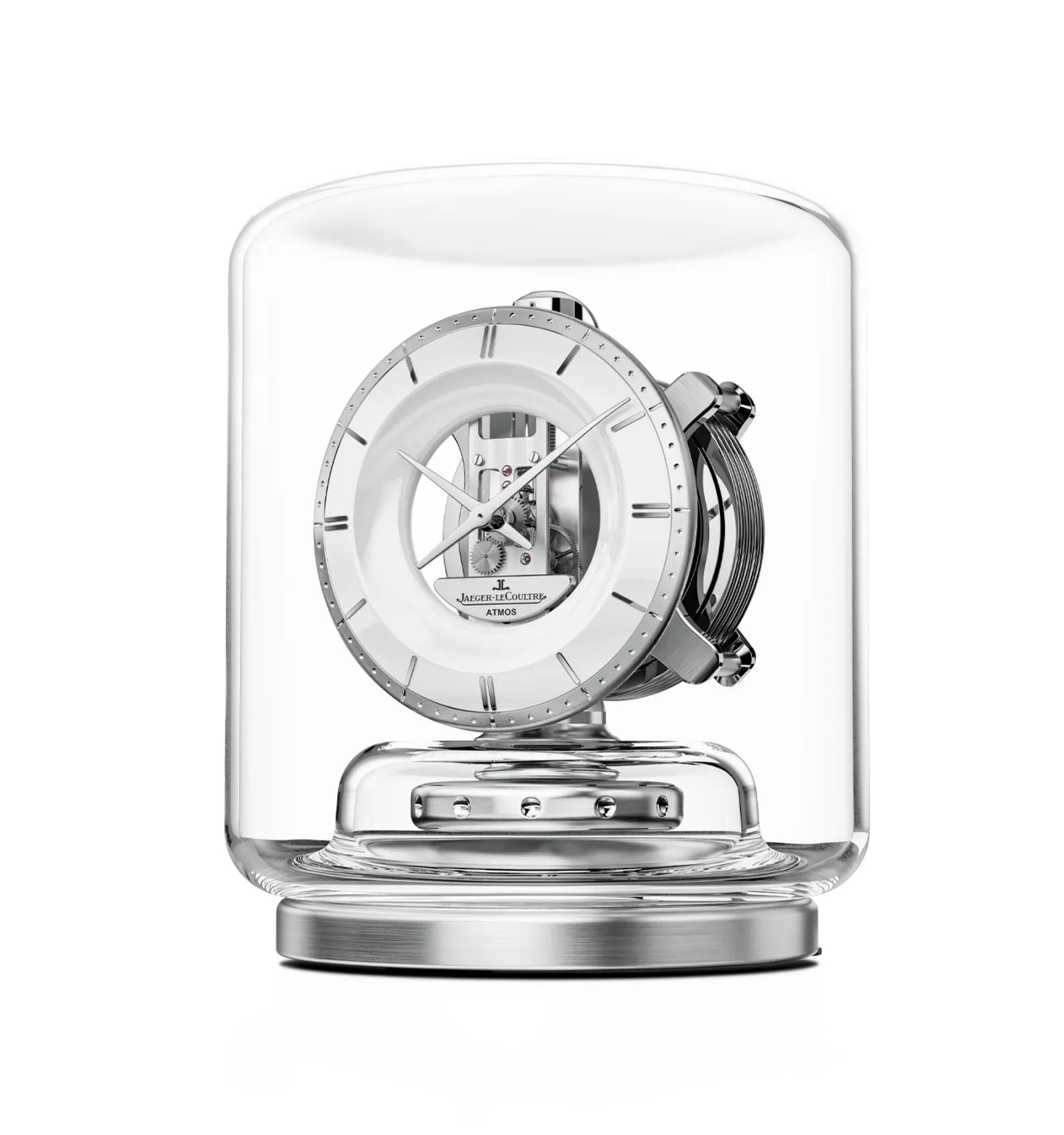
Model History
The Atmos was born from an idea by Swiss engineer Jean-Léon Reutter, who in 1928 conceived a clock capable of winding itself not through gravity or motion, as with automatic wristwatches, but through variations in the temperature of its surrounding environment. The principle relies on a sealed capsule containing a gas mixture that expands or contracts with even the slightest change in ambient temperature, generating the mechanical energy needed to wind a mainspring through a system of levers. Jaeger-LeCoultre recognizes the invention's potential and acquires its rights, filing the relevant patents in France in 1936 and in Switzerland in 1937, after developing the first prototypes, designated as Atmos 0.
Taking Reutter's idea from prototype to industrial production, however, requires years of technical refinement. The highly volatile and partly toxic gas used in the original capsule is replaced with a more stable and safer mixture, and the balance wheel is redesigned to oscillate far more slowly than that of a conventional watch, reducing energy consumption by roughly 250 times compared to an ordinary wristwatch. The result is a mechanism of extraordinary efficiency: a temperature variation of just one degree Celsius over the course of a day is enough to provide roughly 48 hours of power reserve, meaning that the normal thermal swings between day and night are, under normal conditions, enough to keep the clock running indefinitely without any manual intervention.
From the late 1930s onward, the Atmos takes on the industrial form that made it famous: the mechanism enclosed in a gilded or chromed base and topped with a transparent glass dome, allowing the slow, hypnotic motion of the balance wheel to be observed. Over the course of the 20th century the clock becomes a recurring institutional gift, presented to heads of state, ambassadors and high officials on diplomatic occasions, earning it the informal nickname "the presidents' clock". In more recent years the manufacture has paired its classic models with contemporary reinterpretations by outside designers, such as the Atmos designed by Marc Newson in 2008, which reinvents the case's form in sculptural fashion while keeping intact, inside, the same mechanical principle devised almost a century earlier.
Technical Specifications
Main Executions
Thanks to its extreme energy efficiency, a well-functioning Atmos can theoretically keep running for decades, if not generations, without ever being wound by hand: it only needs the natural temperature variation of a lived-in room. It is precisely because of this almost-perpetual nature that, over the course of the 20th century, it became one of the most frequent official gifts among heads of state and high institutional officials, earning it the nickname "the presidents' clock".