

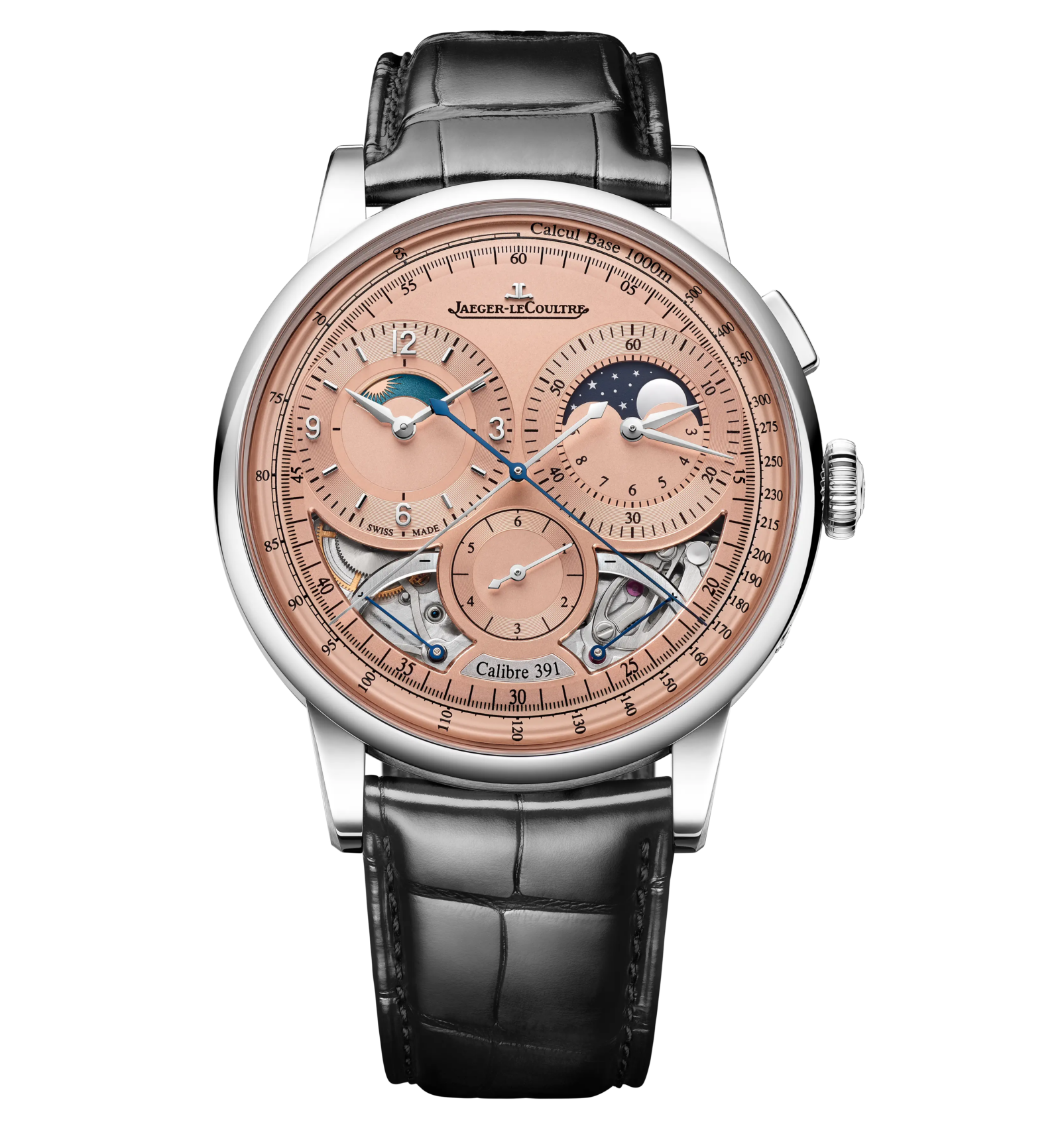
Duomètre
Model History
The Duomètre debuts in 2007 with the line's first model, the Duomètre à Chronographe, the result of an in-depth study carried out by the manufacture's technicians on a minute-repeating pocket chronometer dating back to the 1880s, held in Jaeger-LeCoultre's historical collection. That antique piece, built by the celebrated Vallée de Joux watchmaker Victorin Émile Piguet, featured a dual-drive mechanism that directly inspired the technical architecture of the new contemporary calibre, giving rise to one of the most original innovations in 21st-century mechanical watchmaking.
The problem the Duomètre sets out to solve is as concrete as it is deeply rooted in the history of complicated watchmaking: in a traditional chronograph, activating the complicated function draws energy from the same gear train and the same barrel that drives the watch's timekeeping, often causing a loss of balance-wheel amplitude of up to 40 degrees and a faster depletion of the power reserve, with direct consequences for precision. The Dual-Wing system patented by Jaeger-LeCoultre tackles the problem at its root: two independent barrels power two separate gear trains, one dedicated exclusively to timekeeping (the "time wing"), the other to the complication (the "function wing"), linked only by a single shared regulating organ — the balance wheel — through a synchronization mechanism that transfers no energy from one side to the other.
Making this architecture even more tangible is a detail visible directly on the dial: a small "foudroyante" seconds hand, which ticks several times per second driven solely by the timekeeping train, offers immediate visual proof that the operation of the complication, however complex, is in no way disturbing the precision of the time display. Over the years the Duomètre family has expanded well beyond the original model: alongside the 2007 Chronographe have come the Quantième Lunaire, with calendar and moon phases, the Unique Travel Time, with a jumping second time-zone hand, and the Sphérotourbillon, which applies the Dual-Wing system to a dual-axis tourbillon, among the most sophisticated complications ever produced by the Le Sentier manufacture.
Technical Specifications
Main Executions
The idea behind the Dual-Wing system did not come from a contemporary research lab, but from the direct study of a minute-repeating pocket chronometer from the 1880s, held in the manufacture's historical collection and built by Vallée de Joux watchmaker Victorin Émile Piguet: an idea over a century old, reinterpreted with the metallurgy and constructive precision of the 21st century.