

Polaris
Model History
The Polaris name first appears in 1968 with the Memovox Polaris, a diving watch with an unusually large case for its time, designed to address a very specific technical problem: how to guarantee water resistance without giving up the alarm function, a distinctive feature of the Memovox family, which requires the sound produced by the mechanism to be clearly audible even with the case closed. Jaeger-LeCoultre's solution is a triple-case system: a watertight outer case, a sealed intermediate case protecting the movement, and an inner case connected to the crown, which allows the alarm to be set while still preserving the watertightness of the whole assembly. An internal rotating bezel, operated by a second crown, allows dives to be timed.
The alarm function does not originate with the Polaris but has roots in earlier years: already in 1950 Jaeger-LeCoultre had introduced the first Memovox, a wristwatch with a hand-wound mechanical alarm, followed in 1956 by Calibre 815, which made the Memovox automatic as well — the first watch in history with an alarm and automatic winding. The 1968 Polaris applies this technical heritage to a new context, that of the diving watch, in a decade when professional and recreational diving was becoming a central theme for the entire Swiss watch industry.
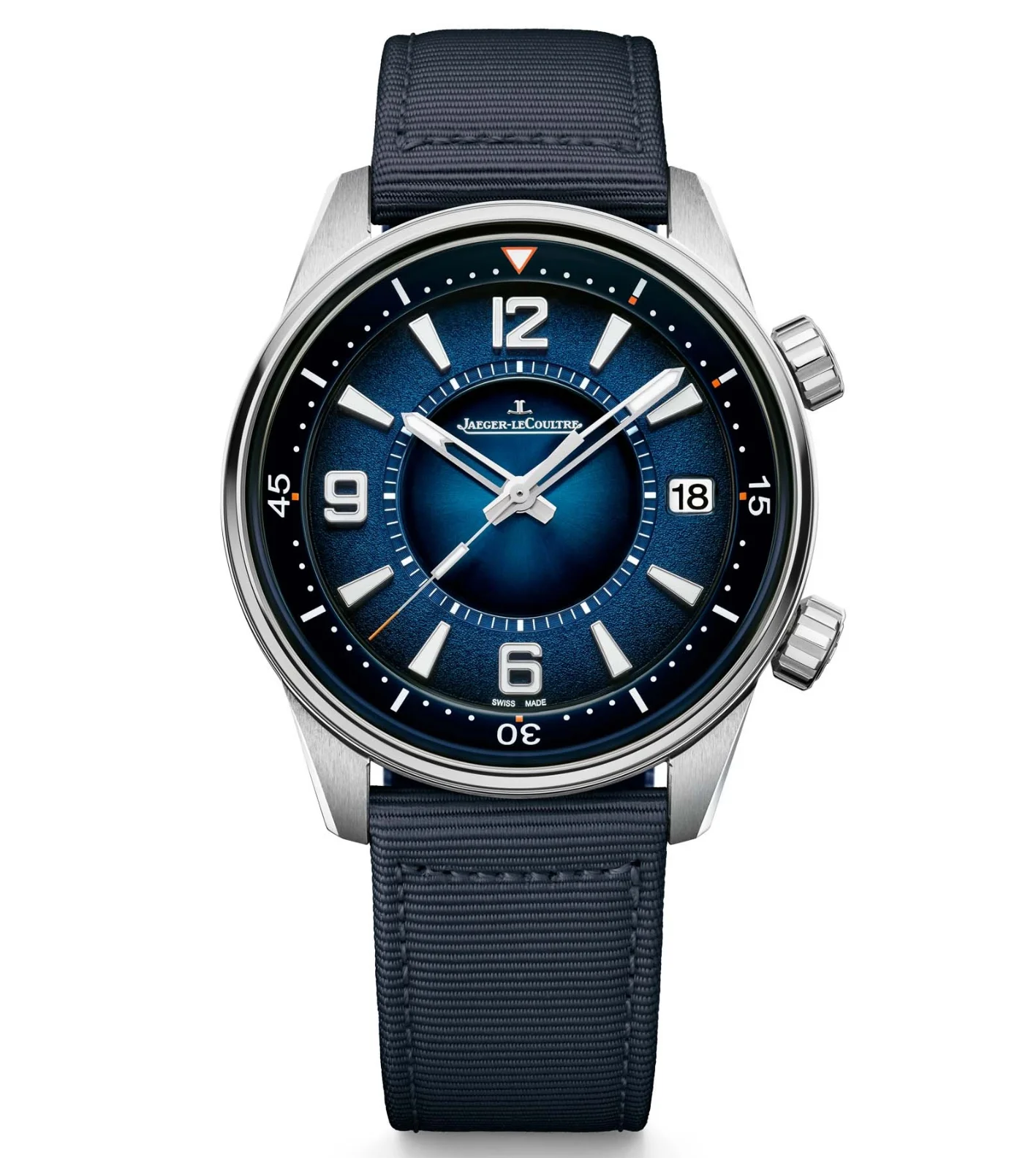
After a long period away from the current catalogue, the Polaris name returns to prominence starting in 2008, recalled in certain executions of the Master Compressor Diving line inspired by the original design, before being fully relaunched in 2018 as a standalone collection. The contemporary Polaris reinterprets the codes of the historic model — internal bezel, opaline blue dial, dauphine hands and faceted luminescent indices — with modern automatic in-house movements and interchangeable straps in leather, metal or rubber, while certain Memovox executions keep alive the alarm function that made the original model famous.
Today the Polaris represents the sporty soul of the Jaeger-LeCoultre catalogue, the natural counterpart to the formal restraint of the Master Control and the architectural eccentricity of the Reverso: a watch designed for contemporary adventure that nonetheless does not give up the aesthetic and technical language inherited from its 1968 forebear.
Technical Specifications
Main Executions
The triple-case system devised for the 1968 Memovox Polaris is one of the most ingenious solutions ever adopted for an alarm watch: it had to solve a seemingly contradictory problem, namely sealing the movement watertight against water without muffling the sound of the alarm mechanism, which had to remain clearly audible even with the case fully closed.