

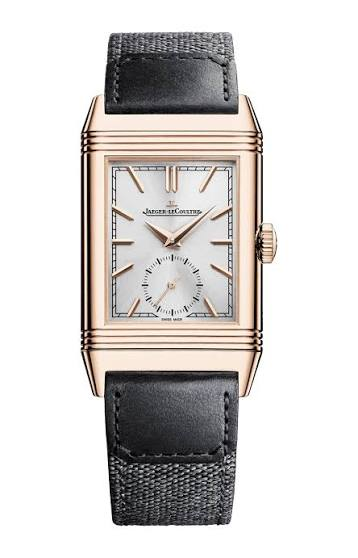
Reverso
Model History
The story of the Reverso begins in 1930, when businessman César de Trey, returning from a trip to India, tells Jacques-David LeCoultre about a very concrete problem: British officers who played polo regularly broke the crystals of their watches during matches, striking them with the mallet or the ball. From this practical need comes an idea as simple as it is brilliant: a case able to slide on its support and flip completely over on itself, so as to protect the dial while leaving only the solid metal back exposed. The design is developed with engineer René-Alfred Chauvot, the patent is filed in Paris on March 4, 1931, and in November the name "Reverso" is registered: production begins almost immediately.
The case design fully reflects the Art Deco taste of the era: clean rectangular lines, square corners and, on the two short sides, three horizontal grooves — the so-called "gadroons" — which originally had a mechanical function, helping the case slide on its support carriage during the flip, and which have remained ever since the model's most recognizable stylistic signature. The solid back, originally conceived as simple protection, has over time become a surface for personalization: hand-painted enamels, engravings, heraldic crests and miniatures have made every Reverso, potentially, a unique piece.
In the following decades the line has grown richer with ever more sophisticated complications, exploiting the movement's distinctive rectangular shape for technical solutions difficult to replicate on a round case. In 1991, for the sixtieth anniversary, comes the Reverso Soixantième with the line's first true mechanical complications; in 1994 the Duoface debuts, with Calibre 854 and two independent dials for reading two time zones simply by flipping the case; in 1997 it is the turn of the Duetto, Calibre 844, aimed at a female audience. In 2006 the manufacture presents the Reverso Grande Complication à Triptyque, the first watch in history with three dials animated by a single movement, testament to how far the reversible architecture invented in 1931 can be pushed.
Even today the Reverso remains the watch most immediately associated with Jaeger-LeCoultre: over fifty rectangular calibres developed specifically throughout its history, a design that has never really stopped being produced since 1931, and an Art Deco aesthetic that continues to be reinterpreted, generation after generation, in ever new ways.
Technical Specifications
Main Executions
The three horizontal grooves on the case's short sides, today a purely decorative element and the Reverso's true stylistic signature, originally had a function that was anything but aesthetic: they helped the case slide on its support carriage during the flipping motion, following the mechanics devised in 1931 by Jacques-David LeCoultre and René-Alfred Chauvot to solve the problem of polo players' broken watch crystals.