

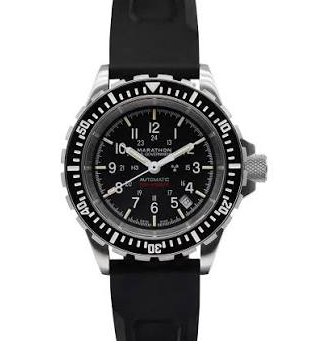
Search and Rescue
Model History
The first Search and Rescue, now remembered as the OSAR (Original Search and Rescue), debuted in 2001 as the first true diving watch made by Marathon: a Parkerized 316L steel case, tritium tubes on the indices and water-resistance certification to 300 meters under the ISO 6425 standard, designed for military diving and search and rescue teams.
From that first model the family quickly expanded in several directions: the GSAR (Government Search and Rescue), an automatic version with a Sellita SW200-1 movement and a particularly thick unidirectional bezel, became the most widespread model in the line during the 2000s; the TSAR, a quartz variant sometimes jokingly described as the GSAR's "little sister," carries over its setup with a battery-powered movement. Alongside these two main versions, size variants coexist — the 46 mm JSAR and the more compact 36 mm MSAR — along with special editions such as the JDD, a bilingual English/French version made for the Canadian Armed Forces, recognizable by its two tritium tubes positioned at 12 o'clock.
The whole family shares the same technical cornerstones: 300-meter water resistance, sapphire crystal, tritium tube illumination paired with the proprietary "MaraGlo" photoluminescent paint on the bezel marker, and a three-piece rubber strap made directly in La Chaux-de-Fonds. Supplied directly to units such as the US Marine Corps and the Canadian Armed Forces, alongside sales to the public, the Search and Rescue line is the one that, more than any other, has introduced Marathon to civilian collectors, well beyond its original circle of military and government customers.
Technical Specifications
Main Executions
The Search and Rescue line's durability has in recent years also caught the attention of the intelligence world: Marathon made its first titanium case precisely for a special SAR edition developed together with Watches of Espionage, a community linked to the world of espionage and special operations — a sign of how much the line remains a reference point even outside the most traditionally military contexts.